10 Reasons Hotel Managers Are Rethinking Their Lobby Market
Hotel managers are under pressure from every direction.
Guests expect more convenience. Staff is stretched. Operating costs keep rising. Restaurants and room service may not be available around the clock. And the lobby market, pantry shelf, or sundry area often becomes one more thing the front desk team has to manage.
That is the problem.
A hotel market should improve the guest experience. It should not create extra work, inventory headaches, shrinkage, empty shelves, or late-night complaints.
That is why more hotels are looking at smart vending machines, micro-markets, and professionally managed grab-and-go setups as a better way to offer 24/7 convenience.
For hotel managers, the opportunity is not just snacks and drinks. It is a cleaner, smarter, more measurable guest amenity that can reduce operational friction and create potential incremental revenue.
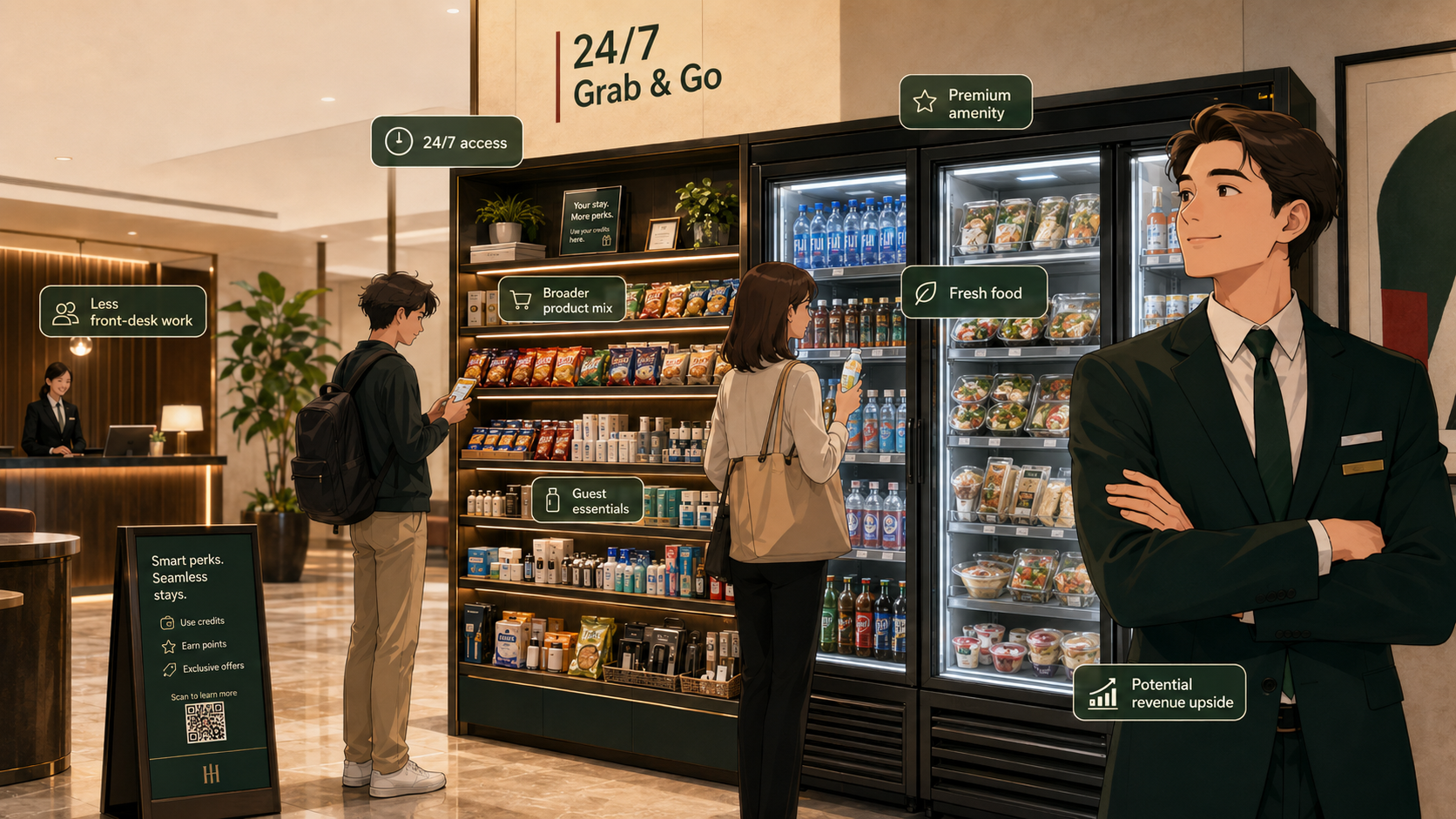
A modern hotel grab-and-go market helps guests find snacks, drinks, fresh food, and essentials 24/7 while reducing front-desk workload.
1. It Solves the Late-Night Guest Problem
Every hotel manager knows this situation.
A guest arrives late. The restaurant is closed. Room service is unavailable. The nearby store is too far away. The guest needs water, a snack, a toothbrush, cold medicine, or a phone charger.
A smart vending or micro-market setup gives guests access to important items 24/7 without asking the front desk to solve every late-night request manually.
For the guest, it feels convenient.
For the hotel team, it removes one more interruption.
2. It Takes Retail Work Off the Front Desk
A lobby market may look simple, but it still has to be operated.
Someone has to check inventory, reorder products, stock shelves, handle missing items, answer guest questions, deal with payment issues, and remove expired products.
That is retail work.
With TraXXable, the hotel does not have to run the market. We handle stocking, product selection, maintenance, payments, support, and ongoing optimization so the hotel team can stay focused on hospitality.
3. It Helps Capture More Guest Spend On Property
Hotels already have the guest traffic.
The question is whether they are capturing enough of the guest’s convenience spend.
A bottle of water after check-in. A protein drink before a meeting. A fresh meal after a late arrival. A snack before an early flight. A forgotten charger. Individually, these purchases may seem small. Across hundreds of rooms and thousands of guest nights, they add up.
This matters because food and beverage has become one of the brighter areas in hotel revenue. CBRE reported that hotel F&B revenue per occupied room grew 3.8% during the first half of 2025, outpacing the 3.0% increase in total hotel revenue during the same period.
A modern grab-and-go setup gives hotels another way to capture that convenience spend without building a restaurant, extending room service, or asking the front desk to manage retail.
4. It Turns the Market From a Side Chore Into a Better-Run Amenity
Many hotel markets are treated like a side task.
They exist because guests need convenience, but they are not always managed like a real retail operation.
That can lead to missed revenue, poor product selection, empty shelves, expired items, shrinkage, and uncertainty about whether the market is actually profitable.
A professionally operated setup changes that.
The goal is not just to sell products. The goal is to run the market better.
5. It Creates Potential Revenue-Share Upside
A modern hotel market can be more than a convenience feature.
When the right equipment, product mix, pricing, and restocking process are in place, the market can also create potential revenue-share upside for the property.
In one reported hotel case, a 350-room Marriott saw pantry revenue double in the first month after switching to a professionally operated smart retail setup. Results vary by property, but the example shows how much upside may exist when a market is stocked, merchandised, tracked, and optimized like retail.
6. It Gives Guests More Than Chips and Soda
A strong hotel market should not only offer snacks.
Guests need practical items: water, energy drinks, protein drinks, fresh meals, desserts, cookies, toothbrushes, toothpaste, deodorant, wipes, feminine care products, chargers, and basic OTC items.
These items are not always exciting, but they matter when a guest needs them.
A forgotten toothbrush or phone charger can become a negative guest moment. A well-stocked smart market can turn that same moment into a simple solution.
7. It Can Add Fresh Food Without Adding a Food-Service Burden
Fresh food can be attractive for hotels, but it can also create operational problems.
🟩 Who orders it?
🟩 Who checks expiration dates?
🟩 Who removes expired items?
🟩 Who tracks what sells?
🟩 Who handles spoilage?
With the right operator, fresh food can be added carefully and adjusted based on real demand.
For TraXXable, that may include working with local partners for prepared options like salads, bowls, wraps, soups, desserts, cookies, cakes, and other grab-and-go items.
8. It Provides Better Inventory Visibility
Traditional shelves and basic pantry setups often leave hotel managers guessing.
🟩 What sold?
🟩 What disappeared?
🟩 What expired?
🟩 What should be restocked?
🟩 What should be removed?
Smart retail technology provides better visibility into product movement.
That allows the product mix to improve over time. If guests buy more sparkling water, zero-sugar drinks, protein options, fresh meals, chargers, or late-night snacks, the assortment can be adjusted.
Instead of relying on a generic hotel market selection, the setup becomes more location-specific.
9. It Supports Hotel Programs, Vouchers, and Special Use Cases
Hotels often need flexibility.
Airline crews may have negotiated discounts. Groups may need snack access. Meeting attendees may want grab-and-go options. A manager may want to offer a guest recovery credit. A hotel may want to support loyalty perks or special events.
Depending on the equipment and platform, smart retail can support credits, vouchers, discounts, guest recovery, airline crew programs, group stays, meetings, and events.
That is much harder to manage with a basic shelf or manual front desk process.
10. It Creates a More Premium Guest Experience
Old vending can feel like an afterthought.
A modern hotel grab-and-go setup should feel intentional.
Clean equipment. Better lighting. Organized products. Easy payment. A stronger product mix. A setup that looks like it belongs in the lobby, not hidden near the ice machine.
That is the mindset shift.
This is not just vending.
It is a hotel amenity.
The Bottom Line for Hotel Managers
A hotel market should not create more work than value.
The right smart vending or micro-market setup can help hotels offer 24/7 convenience, reduce front desk involvement, improve product availability, support fresh grab-and-go options, track demand more clearly, and create potential revenue-share upside.
Hotel guests already spend money on convenience.
The question is whether they spend it on property or somewhere else.
TraXXable helps hotels create modern smart vending, micro-market, and grab-and-go solutions designed around real guest behavior, local demand, and operational simplicity.
