The First 30 Days: Why a Smart Market Shouldn’t Look the Same a Month After Installation
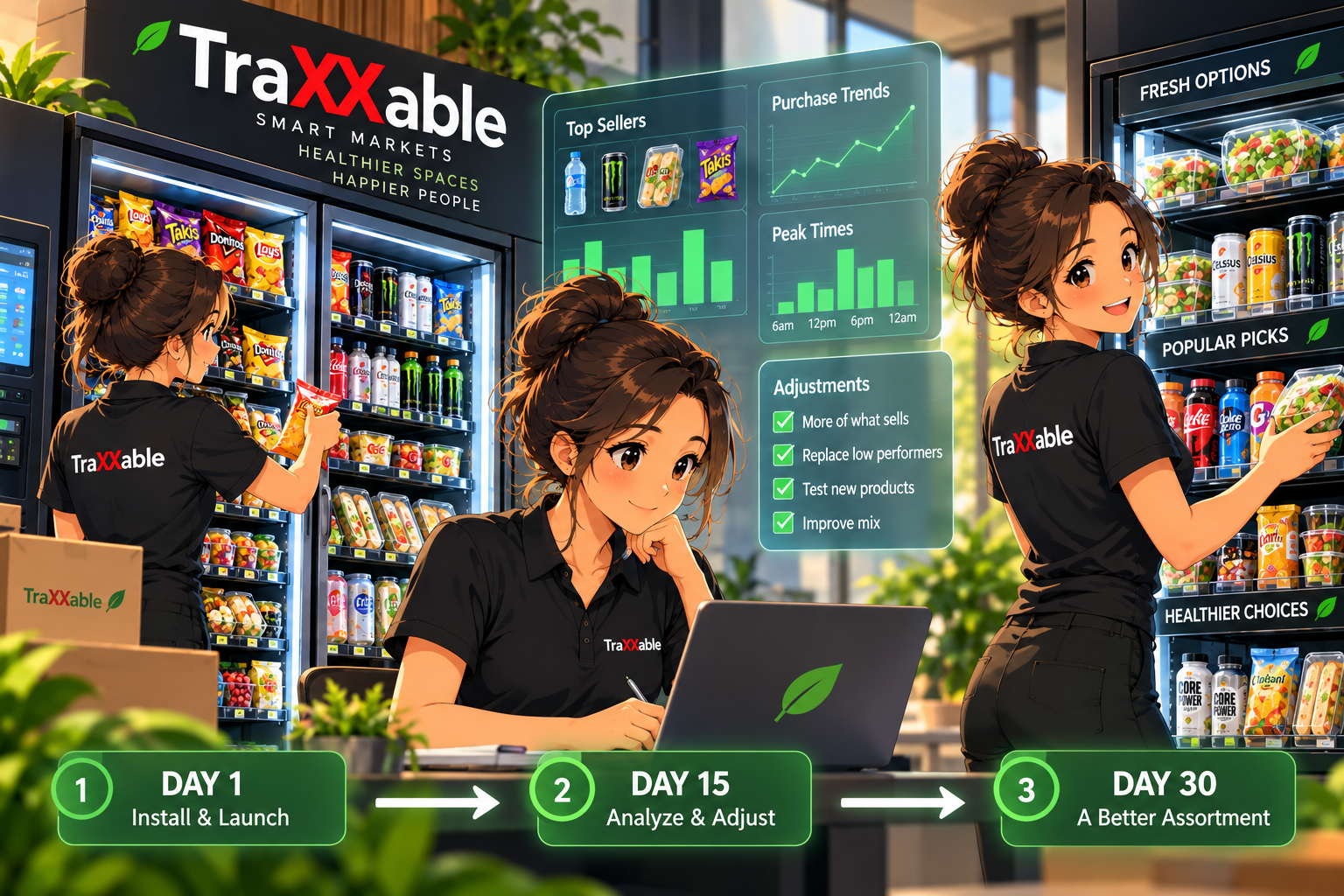
Installation day feels like the finish line.
The equipment is new. The shelves are full. The product mix has been carefully selected. Everything looks exactly as planned.
But from our perspective, that’s when the real work starts.
Because no questionnaire, demographic profile, or previous experience can tell you exactly how a specific group of people will shop.
The first 30 days can.
Day One Is an Educated Guess
Before opening a new TraXXable location, we do our homework.
Who will use it? When are they there? What food options already exist nearby? Are we serving residents, office employees, students, hotel guests, or a combination? What have they told us they want?
All of that helps us create a strong starting assortment.
But it is still a starting point.
People have a habit of surprising you.
The product everyone requested might barely move. Something we expected to sell moderately can suddenly need twice the space. A particular energy drink might dominate mornings, while fresh food performs almost entirely around lunch.
Until people start buying, we don't really know.
Then the Location Starts Talking
Every transaction adds another piece of information.
Not just what sold, but when it sold, what was purchased with it, how quickly it sold, and what customers repeatedly came back for.
Patterns begin to appear.
That's when optimization starts.
We don't react to every unusual day or immediately remove something because it sold slowly for a week. And we don't rebuild an entire assortment because one product suddenly had a great weekend.
We prefer small, consistent changes based on facts, not hunches.
Give a bestseller more space.
Replace a product that consistently underperforms.
Test a new flavor.
Adjust the balance between fresh food, beverages, snacks, and healthier choices.
Then watch what happens.
Why Small Changes Matter
Retail has a temptation to make big changes when something isn't working.
But big changes can also erase what’s working.
A smart market is a system. Products influence one another. Familiar items can drive traffic. Drinks and snacks can help build larger baskets. Fresh food may perform differently depending on what sits around it.
We've seen this in our own transaction analysis: categories that look small based on direct sales alone can play a much larger role in complete purchases.
That's why optimization needs patience.
Change. Measure. Learn. Repeat.
The Technology Makes This Possible. The Service Makes It Useful.
Modern unattended retail gives us access to information traditional vending never could.
But having data and using data are two different things.
That's where the operator matters.
At TraXXable, we use transaction data, customer feedback, and what we observe at the location to continuously refine the offering.
The goal isn't to find the perfect assortment on day one.
The goal is to build a better assortment on day 30 than on day one, and a better one six months later than on day 30.
That's why we don't view unattended retail as equipment you install and occasionally restock.
It's an ongoing service.
Your Market Should Learn With You
Workplaces change. Residents change. Seasons change. Preferences change. New products arrive.
Your retail amenity should be able to change with them.
So if your smart market looks exactly the same six months after installation as it did on opening day, there is a question worth asking:
Is anyone actually learning from what your customers are telling you?
The machine gets installed once.
The learning should never stop.
TraXXable — your local partner in unattended retail.
WHY PROPERTY MANAGERS DON’T WANT VENDING
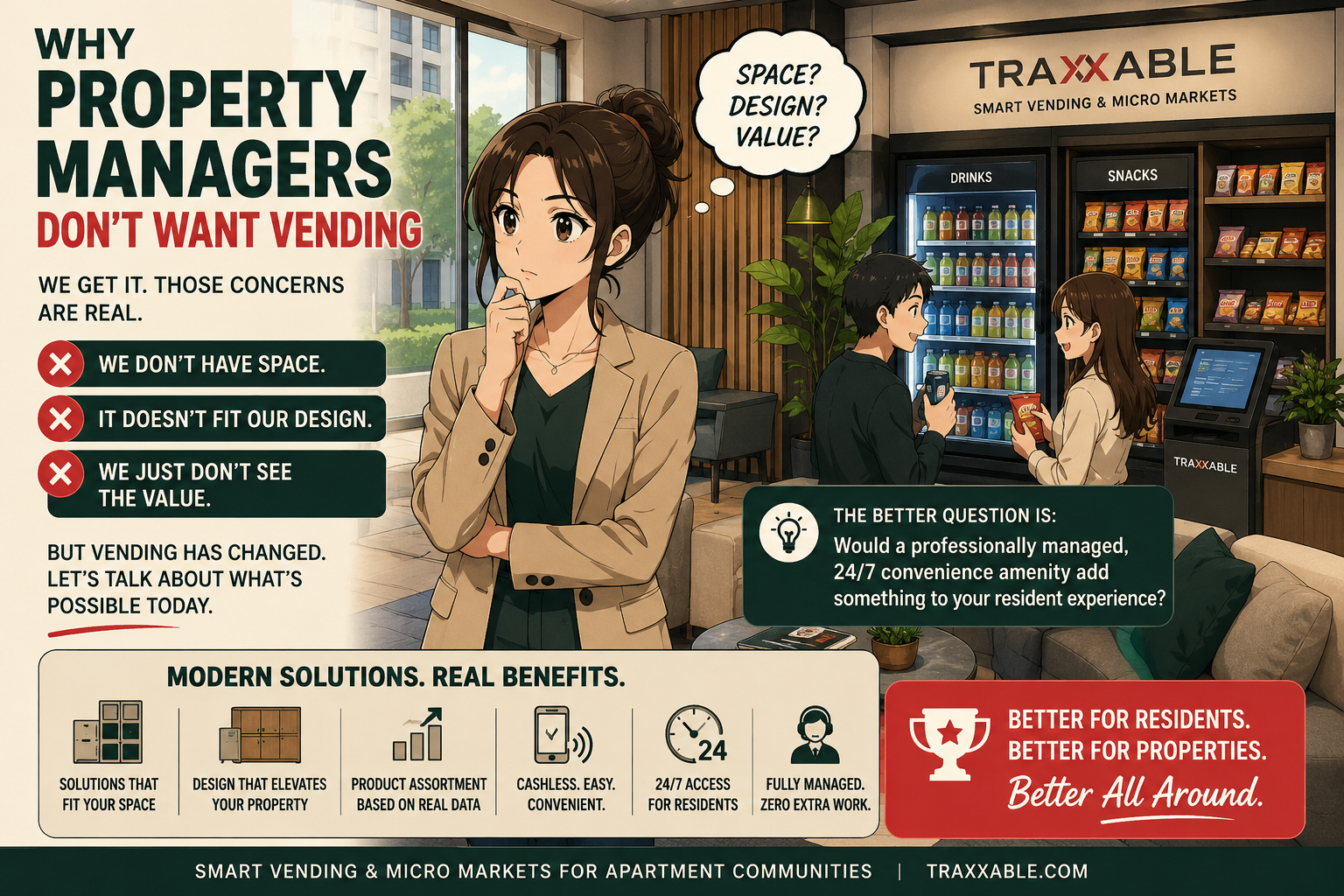
Property managers have plenty of reasons to say no to vending.
There isn't enough space.
It won't match the lobby.
Nobody is sure residents would use it anyway.
And those concerns are fair.
If the only choice were between a boxy traditional vending machine and nothing, many properties would probably be better off choosing nothing.
But that is no longer the choice.
Vending — or what still gets called vending out of habit — has changed considerably.
“We Don’t Have Space.”
Most apartment communities were never designed with vending in mind.
There isn't necessarily an empty wall or dedicated vending area waiting to be filled.
That would matter more if every solution still required the same large, fixed footprint.
Today, modern unattended retail can take many different forms: slim smart coolers, compact smart stores, cabinet-style units, customized fixtures, and full micro markets.
The equipment can increasingly adapt to the available space rather than requiring the property to adapt to it.
So perhaps the better question isn't:
“Where can we put a vending machine?”
It's:
“What would actually work here?”
And increasingly, there may be an answer.
“It Doesn’t Fit Our Design.”
For a premium apartment community, this may be the most understandable objection of all.
Property teams invest heavily in creating attractive lobbies, clubhouses, fitness centers, and resident spaces.
Putting a traditional vending machine in the middle of that environment can feel like a step backward.
It doesn't have to.
At TraXXable, we work with leading smart-retail technology providers including 365 Retail Markets and Cantaloupe. Today's options range from sleek smart coolers and compact stores to complete micro markets.
And the equipment itself doesn't have to define the appearance.
Units can be incorporated into cabinetry, finished with wood panels, or integrated into custom surrounds, so the completed installation feels intentional rather than an afterthought.
The amenity should fit the property, not the other way around.
“We Just Don’t See the Value.”
This is where the conversation gets more interesting.
Residents probably aren't choosing an apartment because it has a vending machine.
But they do value convenience.
A cold drink after the gym.
A snack after getting home late.
Something quick before work.
Having friends over and realizing you're out of drinks.
None of these moments is dramatic.
Most resident experience isn't.
It is built from small conveniences that are easy to overlook individually and much harder to overlook in aggregate.
A professionally managed smart market can provide those moments 24 hours a day, seven days a week, without asking the property team to stock shelves, handle payments, or operate any other amenity.
Maybe Residents Don’t Want “Vending” Either.
And that's okay.
Residents don't necessarily want a vending machine.
They want easy access to products they actually like.
Property managers don't necessarily want another machine to manage either.
They want an amenity that looks like it belongs, is professionally managed, and doesn't become one more item on the team's to-do list.
That gap — between what the word vending still evokes and what residents and property teams actually want — is where modern unattended retail becomes interesting.
Technology enables it.
But technology isn't the amenity.
What matters is where the market is placed, how it is presented, what's stocked, whether service is dependable, and whether the selection continues to adapt based on what residents actually buy.
The hardware is not the point. The resident experience is.
So, Why Don’t Property Managers Want Vending?
Sometimes because there genuinely isn't a good fit.
And that's a legitimate answer.
Not every property needs vending or a micro market.
But sometimes the “no” is aimed at the word vending — and the image that word still creates — rather than at what modern unattended retail can actually look like today.
So perhaps the better question isn't:
“Do you want vending?”
It's:
“Would a professionally managed, 24/7 convenience amenity add something to your resident experience?”
That's a conversation worth having.
Vending Is Dead: Why Modern Retail Setups Are Becoming Amenities
For years, vending was treated as a basic convenience.
A machine in the corner. A few familiar products. Something useful to have, but rarely something anyone considered part of the property experience.
That is changing.
Today, property managers, HR teams, and workplace leaders are thinking differently about the spaces people use every day.
A modern unattended retail setup can offer fresh meals, premium beverages, healthier choices, everyday essentials, frozen products, and familiar favorites; all available 24/7.
But the biggest change isn't what's inside the machine.
It's how the entire experience is presented.
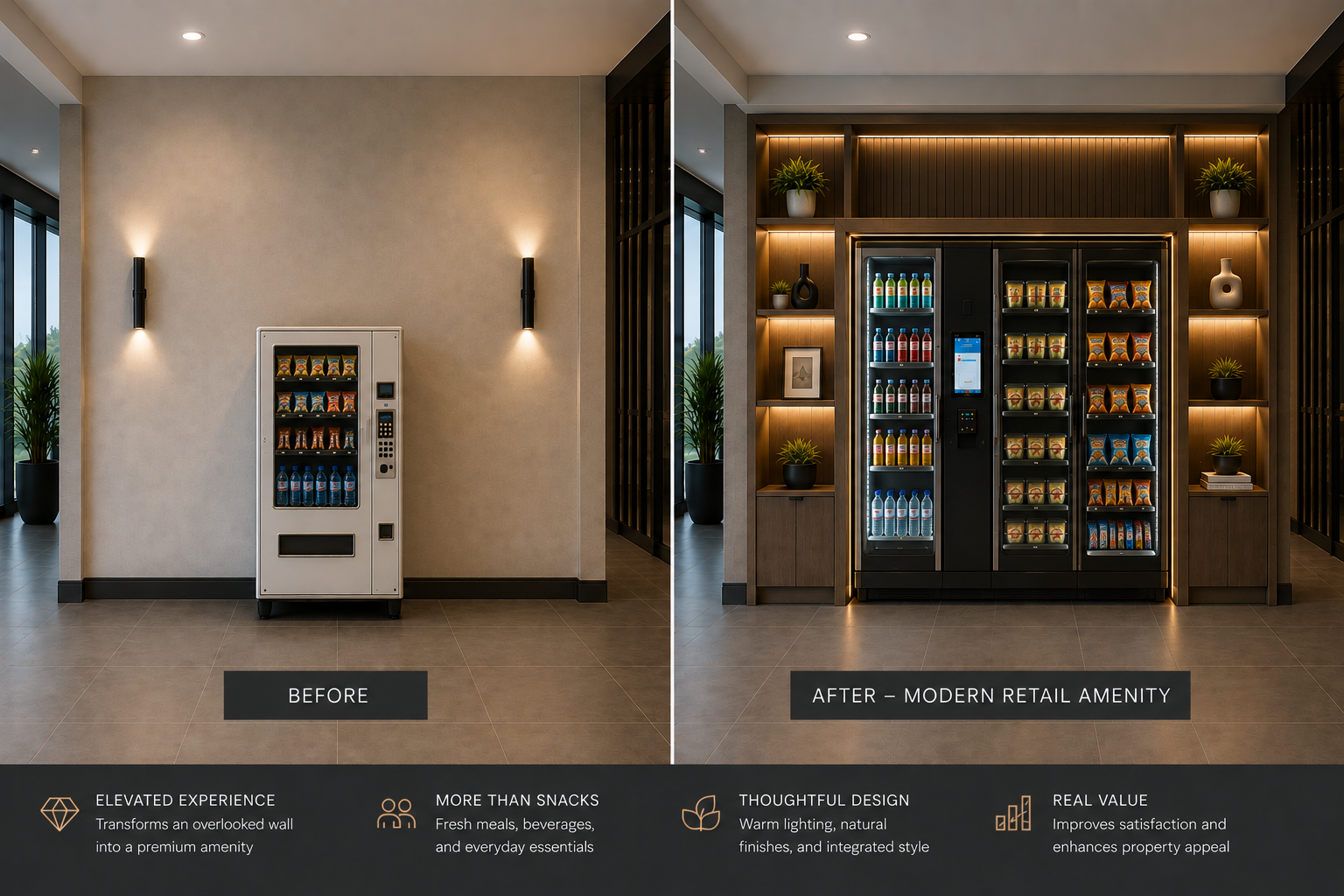
From Machine to Amenity
Put a smart retail unit against an empty wall, and people may still see a machine.
Integrate that same technology with thoughtful lighting, architectural finishes, shelving, signage, and a design that fits the property, and the perception changes.
The technology may be identical.
The products may be identical.
The experience isn't.
We call this the Frame Effect.
The surroundings tell people whether they're looking at a piece of equipment or an amenity designed specifically for their building.
A Small Space Can Make a Big Impression
Modern unattended retail doesn't necessarily need a dedicated room or a large traditional market.
An unused wall, lobby niche, break area, or overlooked corner can become a valuable asset.
The right lighting creates warmth. Wood and other finishes connect the setup to the existing interior. Shelving can provide additional functionality or simply give the space visual balance.
And the setup itself can range from a single smart cooler to refrigerated, ambient, and frozen units or a complete micro market where the location supports it.
The goal isn't to put as much equipment into the space as possible.
It's to make the right setup feel like it belongs there.
Every Location Deserves a Different Answer
An upscale apartment community shouldn't have the same setup as a manufacturing facility.
A boutique hotel shouldn't look like an office breakroom.
And a modern workplace has different needs again.
The people are different. The products are different. The architecture is different.
So why should the retail setup be the same?
At TraXXable, we consider location, traffic, available space, customer needs, product requirements, and surrounding design before recommending a solution.
Sometimes less is more.
Sometimes a forgotten wall can become one of the most useful spaces in the building.
The Experience Is the Amenity
Modern unattended retail is no longer simply about giving people somewhere to buy a snack.
When done well, it adds convenience, food, essentials, and 24/7 access while becoming part of its environment.
And that changes how people perceive it.
The technology provides access.
The products provide choice.
The design creates the experience.
Vending was about the machine.
Modern unattended retail is about everything the machine makes possible.
That's the difference between filling an empty wall and creating an amenity.
TraXXable — your local partner in unattended retail.
The 27% Trap: Why Chips and Sodas Matter More Than Their Sales Suggest
Here's a grocery store secret most people never notice.
Milk sits at the back of the store on purpose. Not because it's unpopular, but because it's one of the most reliable purchases in the store. Grocers know people will walk the aisles to get it, picking up a few extra items along the way.
One product on the shopping list becomes six in the cart.
There's a name for this: milk is a traffic driver. Its job isn't just to sell milk. It's to create visits that lead to additional purchases.
Chips and sodas play the exact same role in a smart vending program.
Most people never think about them that way.
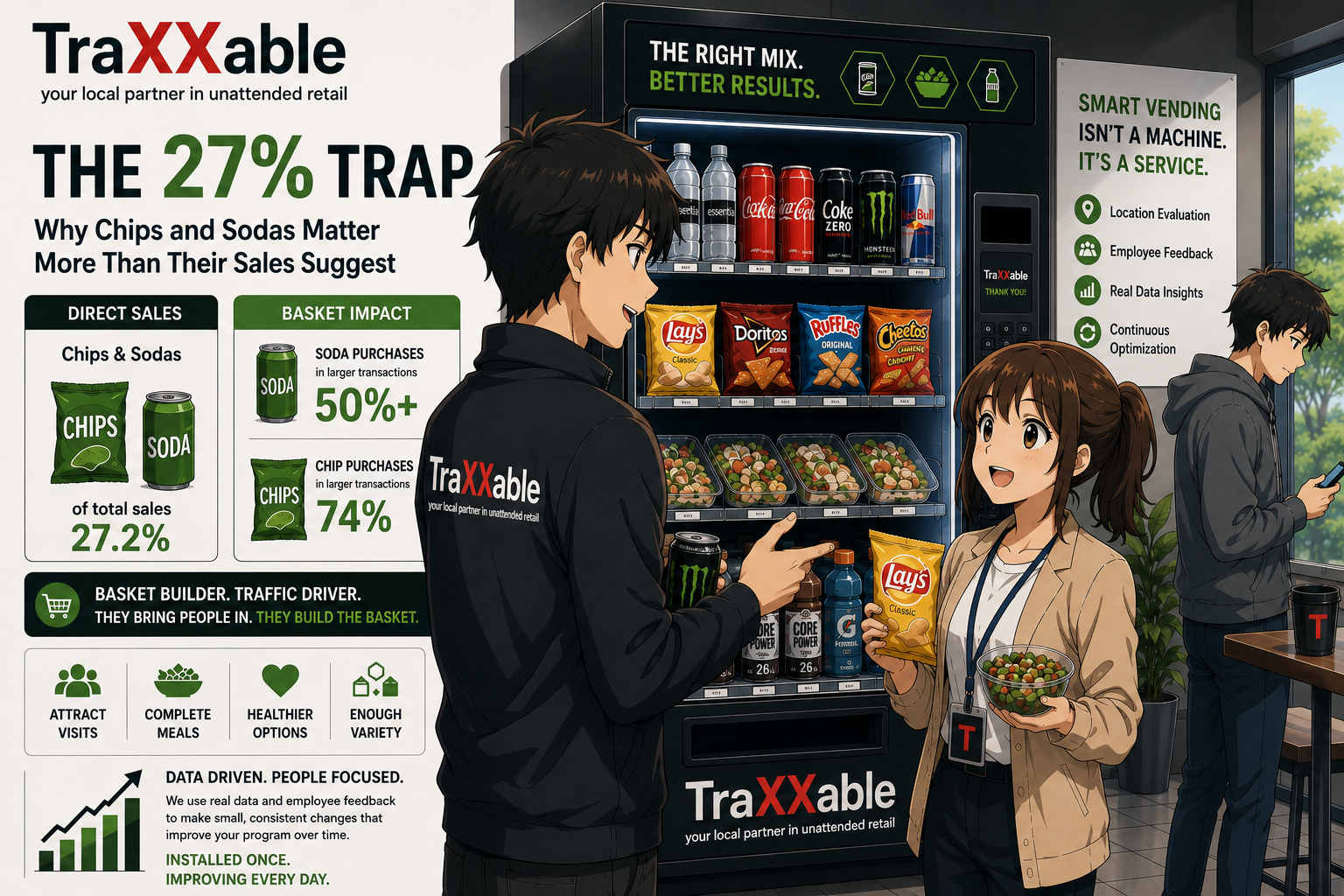
The right mix doesn’t happen by accident. Let TraXXable build and continuously improve the food program your workplace will actually use.
The Stat That Undersells Itself
Look only at direct sales, and chips and sodas seem like minor players.
In one workplace analysis, they represented just 27.2% of total sales. On paper, that makes them look secondary, maybe even a category worth shrinking in favor of something "healthier."
The basket data tells a different story.
More than half of all soda purchases were part of a larger transaction. For chips, that number climbed to nearly three out of four.
That's not really about chips or sodas.
It's about what they unlock.
A soda turns a sandwich into a meal. Chips complete a fresh-food purchase. Someone walks over for the familiar item they already know they want. While they're there, they notice the protein snack, the salad, or the new product they hadn't planned to buy.
That's the real job chips and sodas are doing.
They're not just snacks.
They're basket builders.
Why "Healthy" Alone Isn't the Answer
A machine filled only with traditional snacks is limited.
But a machine filled only with healthier products often misses the same opportunity—because it removes the products that encourage people to walk over in the first place.
A healthier machine nobody visits isn't healthier. It's just ignored.
The strongest workplace food programs create balance.
🟩 Familiar drinks and snacks that attract visits.
🟩 Fresh food that turns a quick stop into a complete meal.
🟩 Healthier options for people actively looking for them.
🟩 Enough variety to keep the machine worth visiting.
The goal isn't to choose between healthy and familiar.
The goal is to build a product mix that makes both work together.
This Is Where Technology Becomes a Service
Every smart vending machine collects data.
Very few vending operators actually use it.
At TraXXable, we begin by evaluating the workplace itself: employee schedules, nearby food options, demographics, purchasing habits, and even employee questionnaires. That information helps us design the initial product mix.
Then the real work begins.
Every transaction teaches us something.
Which products attract visits.
Which products build baskets.
Which products quietly stop working.
Instead of making large changes once or twice a year, we make small, consistent improvements based on facts, not hunches.
Some products stay.
Some evolve.
Some are replaced,
The machine is installed once.
The food program keeps improving.
The Difference Between a Machine and a Service
Anyone can install a vending machine.
Building a successful unattended retail program is something very different.
It requires technology, transaction data, continuous optimization, and someone paying attention.
That's what turns a machine into a service.
And that's what allows a workplace food program to become smarter with every transaction.
Because the best vending programs aren't built on day one.
They're continuously refined, one improvement at a time
10 Reasons Hotel Managers Are Rethinking Their Lobby Market
Hotel managers are under pressure from every direction.
Guests expect more convenience. Staff is stretched. Operating costs keep rising. Restaurants and room service may not be available around the clock. And the lobby market, pantry shelf, or sundry area often becomes one more thing the front desk team has to manage.
That is the problem.
A hotel market should improve the guest experience. It should not create extra work, inventory headaches, shrinkage, empty shelves, or late-night complaints.
That is why more hotels are looking at smart vending machines, micro-markets, and professionally managed grab-and-go setups as a better way to offer 24/7 convenience.
For hotel managers, the opportunity is not just snacks and drinks. It is a cleaner, smarter, more measurable guest amenity that can reduce operational friction and create potential incremental revenue.
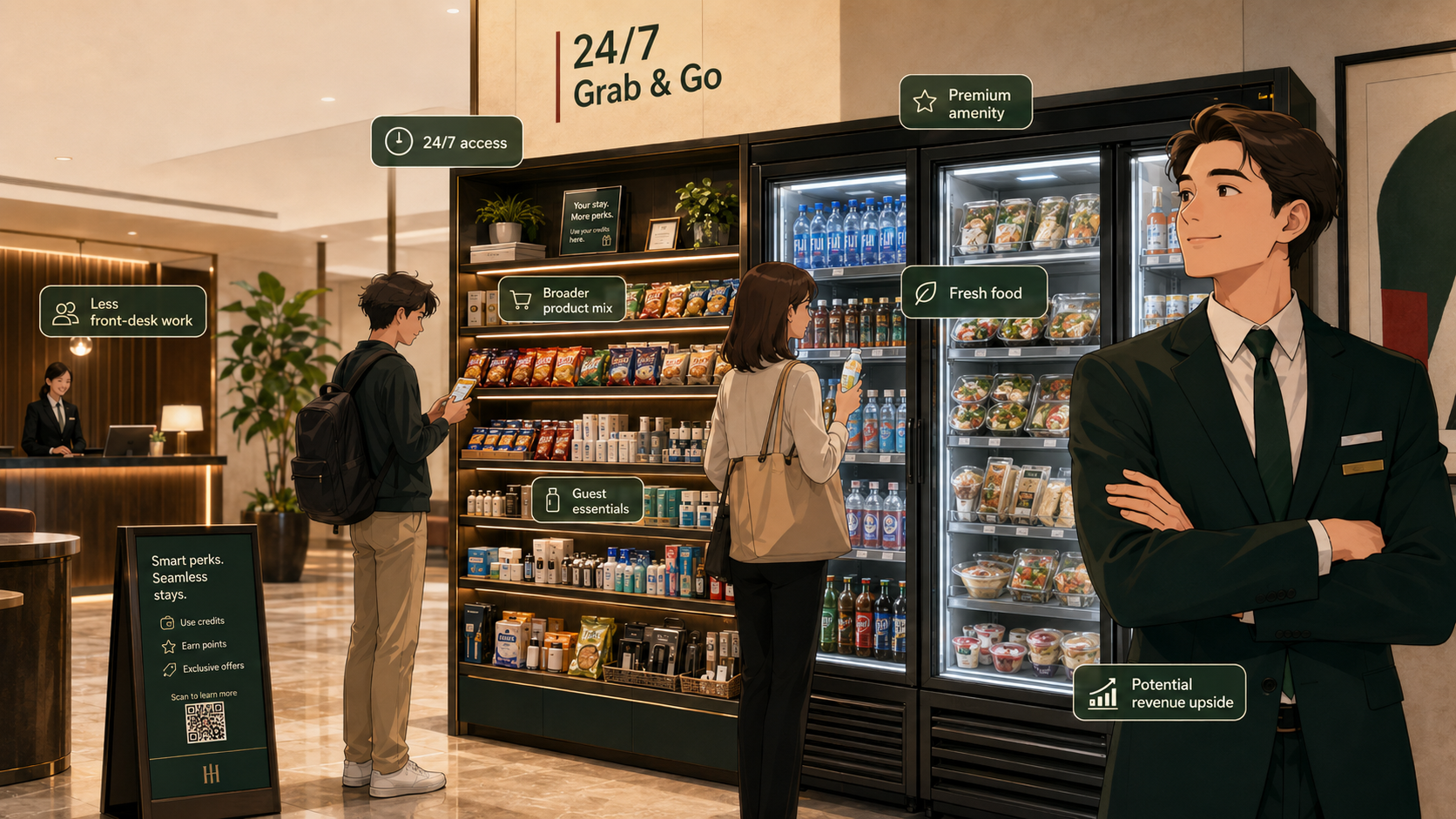
A modern hotel grab-and-go market helps guests find snacks, drinks, fresh food, and essentials 24/7 while reducing front-desk workload.
1. It Solves the Late-Night Guest Problem
Every hotel manager knows this situation.
A guest arrives late. The restaurant is closed. Room service is unavailable. The nearby store is too far away. The guest needs water, a snack, a toothbrush, cold medicine, or a phone charger.
A smart vending or micro-market setup gives guests access to important items 24/7 without asking the front desk to solve every late-night request manually.
For the guest, it feels convenient.
For the hotel team, it removes one more interruption.
2. It Takes Retail Work Off the Front Desk
A lobby market may look simple, but it still has to be operated.
Someone has to check inventory, reorder products, stock shelves, handle missing items, answer guest questions, deal with payment issues, and remove expired products.
That is retail work.
With TraXXable, the hotel does not have to run the market. We handle stocking, product selection, maintenance, payments, support, and ongoing optimization so the hotel team can stay focused on hospitality.
3. It Helps Capture More Guest Spend On Property
Hotels already have the guest traffic.
The question is whether they are capturing enough of the guest’s convenience spend.
A bottle of water after check-in. A protein drink before a meeting. A fresh meal after a late arrival. A snack before an early flight. A forgotten charger. Individually, these purchases may seem small. Across hundreds of rooms and thousands of guest nights, they add up.
This matters because food and beverage has become one of the brighter areas in hotel revenue. CBRE reported that hotel F&B revenue per occupied room grew 3.8% during the first half of 2025, outpacing the 3.0% increase in total hotel revenue during the same period.
A modern grab-and-go setup gives hotels another way to capture that convenience spend without building a restaurant, extending room service, or asking the front desk to manage retail.
4. It Turns the Market From a Side Chore Into a Better-Run Amenity
Many hotel markets are treated like a side task.
They exist because guests need convenience, but they are not always managed like a real retail operation.
That can lead to missed revenue, poor product selection, empty shelves, expired items, shrinkage, and uncertainty about whether the market is actually profitable.
A professionally operated setup changes that.
The goal is not just to sell products. The goal is to run the market better.
5. It Creates Potential Revenue-Share Upside
A modern hotel market can be more than a convenience feature.
When the right equipment, product mix, pricing, and restocking process are in place, the market can also create potential revenue-share upside for the property.
In one reported hotel case, a 350-room Marriott saw pantry revenue double in the first month after switching to a professionally operated smart retail setup. Results vary by property, but the example shows how much upside may exist when a market is stocked, merchandised, tracked, and optimized like retail.
6. It Gives Guests More Than Chips and Soda
A strong hotel market should not only offer snacks.
Guests need practical items: water, energy drinks, protein drinks, fresh meals, desserts, cookies, toothbrushes, toothpaste, deodorant, wipes, feminine care products, chargers, and basic OTC items.
These items are not always exciting, but they matter when a guest needs them.
A forgotten toothbrush or phone charger can become a negative guest moment. A well-stocked smart market can turn that same moment into a simple solution.
7. It Can Add Fresh Food Without Adding a Food-Service Burden
Fresh food can be attractive for hotels, but it can also create operational problems.
🟩 Who orders it?
🟩 Who checks expiration dates?
🟩 Who removes expired items?
🟩 Who tracks what sells?
🟩 Who handles spoilage?
With the right operator, fresh food can be added carefully and adjusted based on real demand.
For TraXXable, that may include working with local partners for prepared options like salads, bowls, wraps, soups, desserts, cookies, cakes, and other grab-and-go items.
8. It Provides Better Inventory Visibility
Traditional shelves and basic pantry setups often leave hotel managers guessing.
🟩 What sold?
🟩 What disappeared?
🟩 What expired?
🟩 What should be restocked?
🟩 What should be removed?
Smart retail technology provides better visibility into product movement.
That allows the product mix to improve over time. If guests buy more sparkling water, zero-sugar drinks, protein options, fresh meals, chargers, or late-night snacks, the assortment can be adjusted.
Instead of relying on a generic hotel market selection, the setup becomes more location-specific.
9. It Supports Hotel Programs, Vouchers, and Special Use Cases
Hotels often need flexibility.
Airline crews may have negotiated discounts. Groups may need snack access. Meeting attendees may want grab-and-go options. A manager may want to offer a guest recovery credit. A hotel may want to support loyalty perks or special events.
Depending on the equipment and platform, smart retail can support credits, vouchers, discounts, guest recovery, airline crew programs, group stays, meetings, and events.
That is much harder to manage with a basic shelf or manual front desk process.
10. It Creates a More Premium Guest Experience
Old vending can feel like an afterthought.
A modern hotel grab-and-go setup should feel intentional.
Clean equipment. Better lighting. Organized products. Easy payment. A stronger product mix. A setup that looks like it belongs in the lobby, not hidden near the ice machine.
That is the mindset shift.
This is not just vending.
It is a hotel amenity.
The Bottom Line for Hotel Managers
A hotel market should not create more work than value.
The right smart vending or micro-market setup can help hotels offer 24/7 convenience, reduce front desk involvement, improve product availability, support fresh grab-and-go options, track demand more clearly, and create potential revenue-share upside.
Hotel guests already spend money on convenience.
The question is whether they spend it on property or somewhere else.
TraXXable helps hotels create modern smart vending, micro-market, and grab-and-go solutions designed around real guest behavior, local demand, and operational simplicity.
The World Cup Is Coming, and Nobody Wants to Leave at Halftime.
Residents gather. Lounges get busy. Friends come over unexpectedly.
And suddenly somebody asks:
“Do we have snacks?”
“Is anything still open?”
“Who wants to drive somewhere?”
That’s when convenience suddenly matters a lot more than most property managers expect.
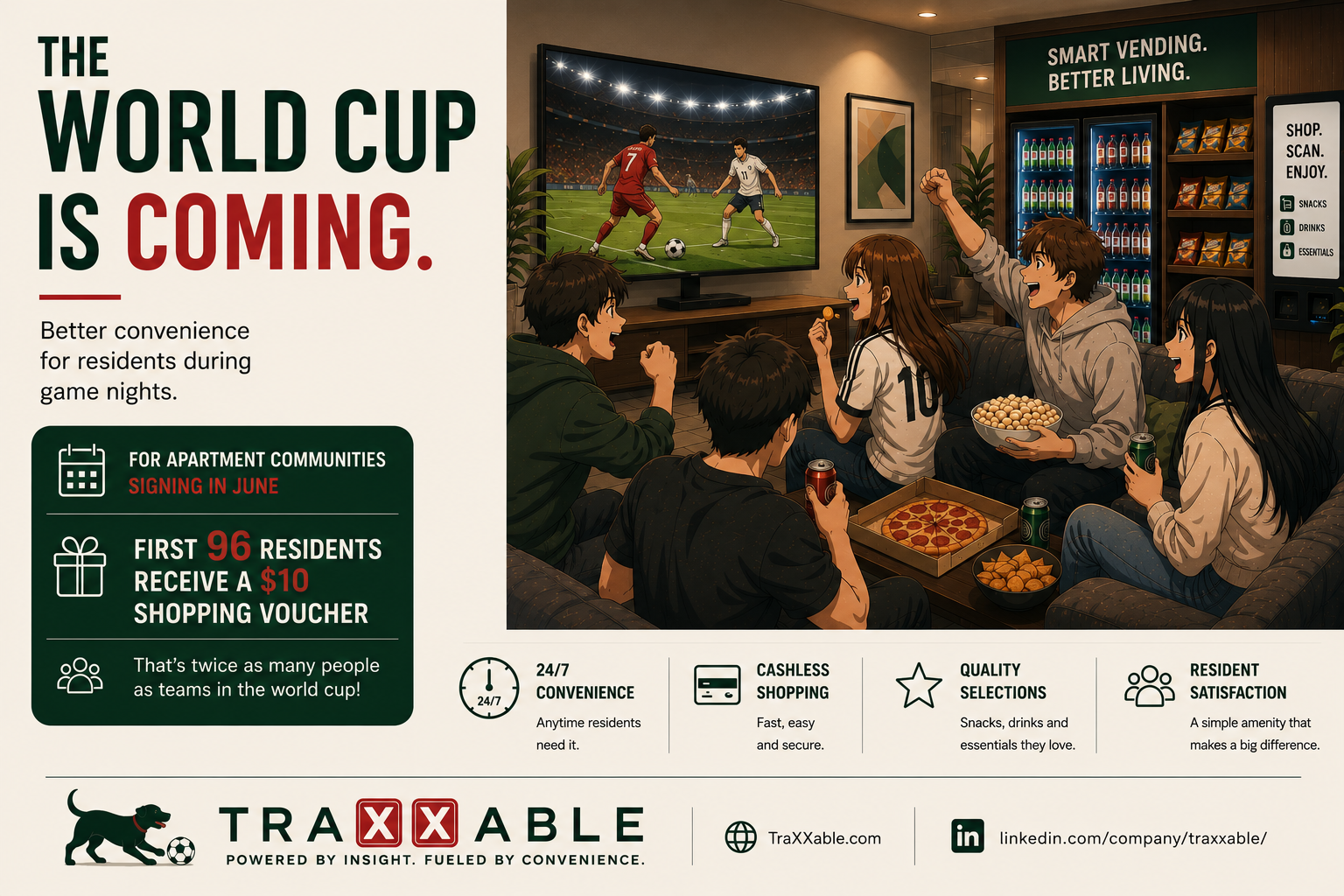
Modern smart vending for apartment communities during World Cup season, offering residents 24/7 access to snacks, drinks, and convenience items without leaving the property.
The Hidden “Halftime Problem”
Most apartment communities were never designed around major game nights.
During events like the World Cup, demand changes quickly. There is more foot traffic, more late-night activity, more group gathering, and more demand for snacks, drinks, and quick meals.
Unlike traditional retail, modern smart vending works 24/7.
No lines.
No staffing.
No leaving the property at halftime.
Modern Vending Isn’t What Most People Imagine
Many property managers still picture old spiral machines, cheap snacks, loud compressors, poor aesthetics, and broken payment systems.
But modern smart vending and micro markets are very different today.
At TraXXable, we work with premium platforms like 365 Retail Markets and Cantaloupe Systems to create setups designed for luxury apartment communities, high-end lounges, premium office spaces, and modern hospitality environments.
Today’s systems can include:
🟩 Glass-front smart coolers
🟩 Compact layouts
🟩 Cashless shopping
🟩 Modern fixture integrations
🟩 App-based rewards & promotions
Because today’s vending shouldn’t feel like vending anymore.
“We Don’t Have Space” Is Usually Solvable
This is one of the most common objections we hear.
But modern equipment now comes in many formats, from slim vertical coolers to compact snack units, corner-friendly layouts, wall-integrated concepts, and small micro market combinations.
The goal is not forcing the property to adapt to the machine.
The goal is designing around the property.
A World Cup Offer Designed for Residents
To celebrate the World Cup season, TraXXable is launching a limited-time promotion for apartment communities signing with us before June.
The first 96 residents who sign up through the app receive a $10 shopping voucher.
That’s twice as many people as teams in the World Cup.
It’s a simple way to:
🟩 Increase resident engagement
🟩 Drive app adoption
🟩 Create excitement around the amenity
🟩 Give residents an immediate reason to try the system
Because nobody wants to leave the property at halftime to hunt for snacks.
Final Thought
The best amenities are the ones residents actually use.
And during the World Cup, convenience becomes part of the experience.
What to Look for When Choosing a Workplace Food Solution in San Diego
Feeding a team sounds simple.
Until someone has to manage it.
For many HR teams, office managers, property managers, and business owners in San Diego, workplace food sits in a difficult middle ground. A full cafeteria may be too expensive. Daily catering may require too much coordination. Stocking a breakroom internally may sound easy at first, but over time, it becomes one more thing someone has to manage.
Inventory. Preferences. Expiration dates. Cleanup. Complaints. Empty shelves. Products nobody wants.
Workplace food is not just about “having snacks.”
It is about convenience, service, flexibility, and creating a better day-to-day experience for the people who use the space.
Here’s what to look for when choosing a workplace food solution in San Diego.
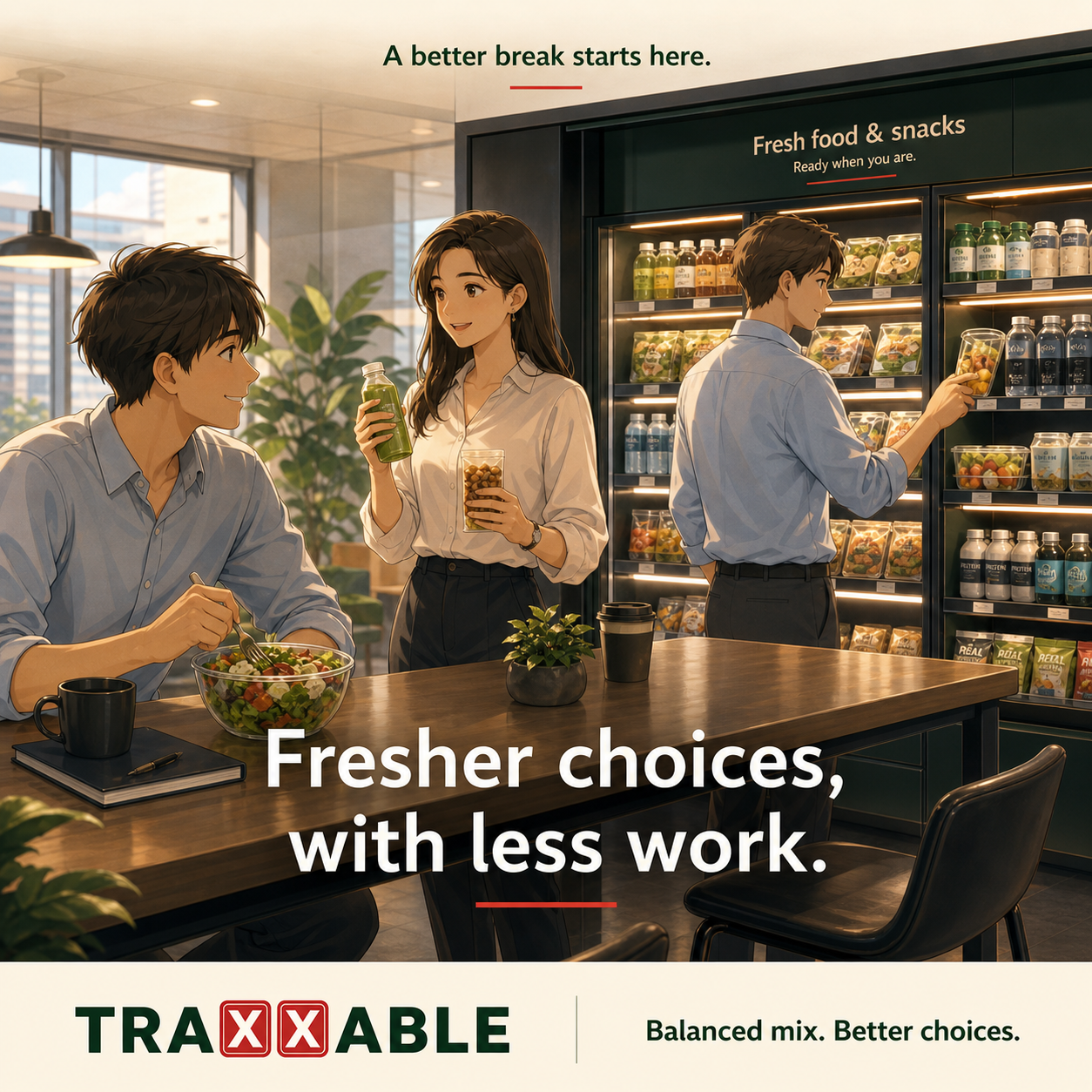
Fresher choices, with less work. Modern grab-and-go food, drinks, and snacks for San Diego workplaces managed by TraXXable.
1. Cafeteria, Catering, or Managed Grab-and-Go?
Not every company needs the same solution.
A cafeteria can work when you have enough people, space, budget, and daily demand to justify it.
Catering works well for meetings, events, planned team lunches, and special occasions.
Managed grab-and-go works for the everyday gaps in between.
The forgotten lunch.
The late meeting.
The quick drink before a call.
The afternoon snack.
The employee who does not have time to leave the building.
For many small and mid-sized San Diego workplaces, the best solution is not a full cafeteria. It is a flexible food-and-drink setup that supports people throughout the day without requiring the company to run its own food program.
2. Who Actually Manages the Program?
This is one of the most important questions.
A workplace food setup should make life easier for HR, office managers, property managers, and operations teams, not harder.
If your internal team has to order products, restock shelves, clean the area, monitor expiration dates, track preferences, handle complaints, and deal with empty inventory, the “simple snack program” can quickly become another job.
A managed solution should include:
🟩 Product stocking
🟩 Inventory monitoring
🟩 Cleaning and maintenance
🟩 Product adjustments
🟩 Service support
🟩 Ongoing optimization
The goal is simple: provide better food and drink access without adding another operational burden.
3. Product Mix and Flexibility
A good workplace food solution should not be static.
What works in one San Diego office may not work in another. A biotech workplace in Sorrento Valley may have different needs than a professional services office in UTC, a medical office in La Jolla, or an apartment community in Mission Valley.
Some teams want sparkling water and protein drinks. Others want coffee drinks, energy drinks, fresh food, healthier snacks, or everyday essentials.
The key is flexibility.
If protein drinks sell, add more.
If sparkling water beats soda, adjust.
If fresh food makes sense, test it.
If certain products sit too long, remove them.
The best workplace food programs improve over time based on what people actually use, not just what someone guessed they might want.
4. Freshness and Presentation
People notice the details.
A workplace food area should look clean, organized, and intentional. Products should be stocked. Machines should be maintained. Expired items should be removed. The setup should feel like an amenity, not an afterthought.
This matters because workplace food is also part of the employee, tenant, and visitor experience.
A clean, well-stocked grab-and-go area sends a simple message:
Someone thought about this.
5. Availability Beyond Lunch
Food needs do not only happen at noon.
People arrive early. They stay late. They have back-to-back meetings. They forget lunch. They need a quick reset during the day.
That is where everyday access matters.
A modern grab-and-go setup can support the moments between formal meals. It gives employees, residents, and guests convenient access to snacks, drinks, fresh food options, and essentials without requiring a scheduled lunch order or a trip off-site.
For many San Diego workplaces and properties, that daily convenience is where the real value shows up.
6. Technology and Ease of Use
Modern workplace food should be simple for the user.
Look for solutions that support:
🟩 Cashless payments
🟩 Tap-to-pay
🟩 Mobile wallet options
🟩 App-based features where useful
🟩 Simple support for refunds or issues
🟩 Remote inventory tracking
The easier the setup is to use, the more likely people are to actually use it.
Technology should reduce friction for both employees and the company.
7. Local Service and Responsiveness
The setup is only as good as the operator behind it.
A machine or mini-market may look good on day one. The real question is what happens after that.
For San Diego businesses and properties, local responsiveness matters.
Ask:
🟩 How often is it restocked?
🟩 Who handles service issues?
🟩 How quickly are problems addressed?
🟩 Can the product mix be adjusted?
🟩 Is there local support?
🟩 Is the setup monitored regularly?
A workplace food solution should not be “set it and forget it.”
It should be managed, monitored, and improved.
8. Cost and Operational Burden
A full cafeteria can be expensive. Catering can add up quickly. Self-stocking can cost more time than expected.
For many workplaces, managed grab-and-go can be a practical middle ground.
It can often be added without a major build-out, without extra staff, without daily ordering, and without internal inventory management.
That is why more San Diego companies and properties are looking for flexible workplace food solutions instead of trying to run everything themselves.
The best solution is not always the biggest one.
It is the one that fits your team, your space, your traffic, and your internal bandwidth.
The Takeaway
The best workplace food solution is not just about food.
It is about fit.
Does it fit your team?
Does it fit your space?
Does it fit your budget?
Does it fit your ability to manage it?
Does it make the workplace easier, or does it create more work?
For some companies, the answer may be catering. For others, it may be a managed grab-and-go setup. For many, it may be a smart combination of both.
At TraXXable, we help San Diego offices, workplaces, apartments, and shared spaces create modern grab-and-go and workplace food solutions that are managed, flexible, and built around how people actually use them.
Want to learn what this could look like for your team or property?
Balanced mix. Better choices.
How HR Teams Can Use Smart Vending to Support, Incentivize, and Engage Employees
Vending is often treated as a convenience.
But with the right setup, it can become something much more practical:
A simple, scalable tool to support employees throughout the workday—without adding operational complexity.
For HR teams, the opportunity is not just in offering vending, but in how it’s used.
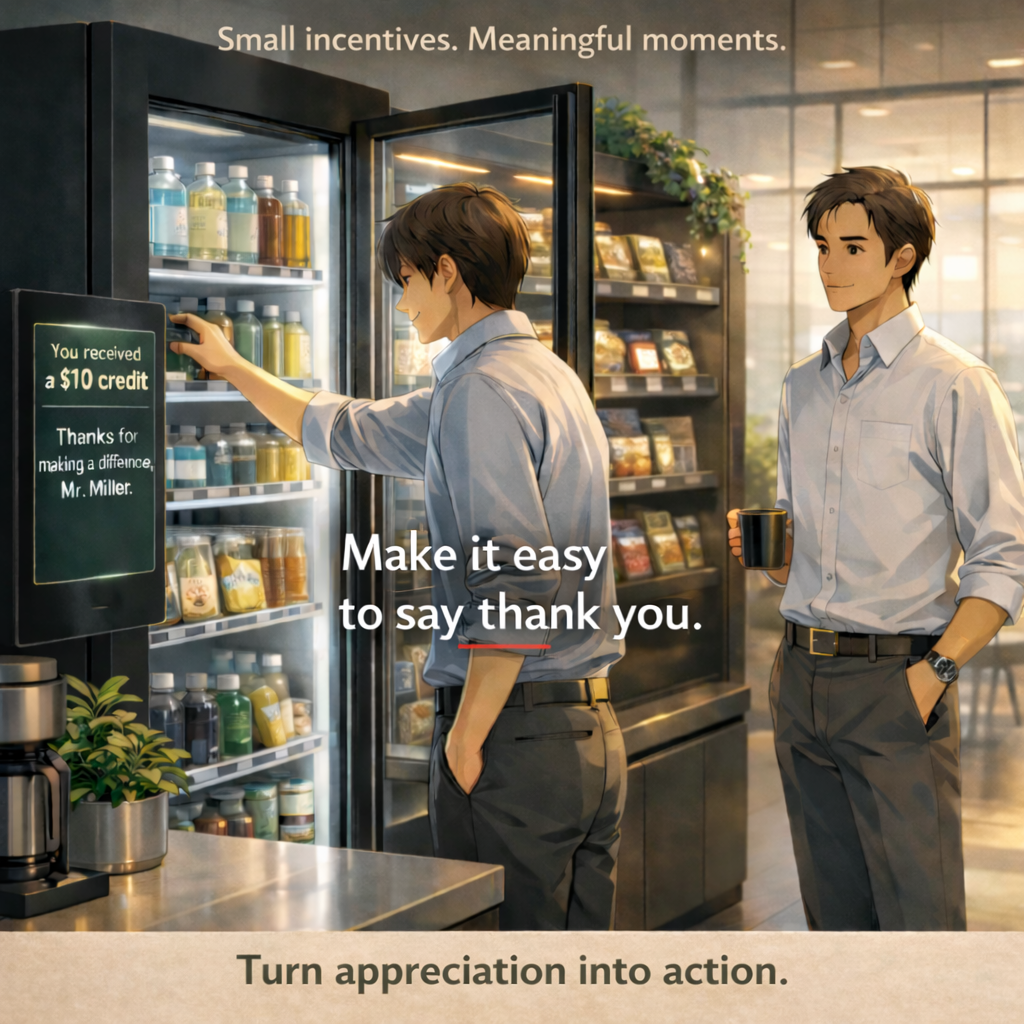
Recognition works best when it’s immediate.
Start with the goal, not the machine
Before introducing any solution, start with a simple question:
What do we actually want to achieve?
Is the goal to:
🟩 support healthier habits at work
🟩 improve day-to-day employee satisfaction
🟩 provide reliable access across multiple shifts
🟩 create simple incentives or recognition moments
🟩 strengthen communication in subtle, everyday ways
Different goals lead to different approaches.
When the goal is clear, the setup becomes much easier to design—and much more effective.
Think beyond snacks: use it as a tool
Modern vending setups, especially those connected to apps or digital systems, allow for much more than simple purchases.
They can be used as a lightweight engagement tool.
For example:
🟩 Team leads can allocate small credits to their teams
🟩 HR can create occasional “thank you” moments
🟩 Companies can support certain behaviors (e.g., long shifts, project milestones)
🟩 Onboarding experiences can include immediate, usable perks
These are not large programs.
They are small, repeatable actions that fit naturally into the workday.
Example: simple team-based incentives
In one common setup, managers are given a small monthly budget.
Instead of formal rewards, they use it informally:
🟩 recognizing extra effort during busy periods
🟩 supporting teams during longer shifts
🟩 offering small gestures after project milestones
Employees don’t need to request anything.
There’s no process to follow.
The credit simply appears—and can be used immediately.
This removes friction and increases actual usage.
Where apps make the difference
Without a connected system, most of this would be difficult to manage.
With app-based solutions, it becomes straightforward:
🟩 credits can be distributed instantly
🟩 usage can be tracked (at a high level)
🟩 limits and budgets can be controlled
🟩 access can be restricted to specific groups if needed
This allows HR teams to introduce incentives without creating new administrative work.
Match the setup to the workplace
Different environments benefit from different approaches.
For example:
🟩 office environments may focus on convenience and small daily perks
🟩 multi-shift operations may prioritize 24/7 availability and energy support
🟩 larger teams (150+ employees) can support broader variety, including fresh food
The key is aligning the setup with how employees actually work—not just what is available.
Keep it simple to sustain it
The most successful implementations share one common trait:
They don’t rely on ongoing effort.
🟩 no manual processes
🟩 no complex approvals
🟩 no additional workload for HR
Everything works in the background.
That’s what allows the system to scale and remain consistent over time.
Direct benefits for HR teams
When used intentionally, vending can support:
🟩 everyday employee satisfaction
🟩 small, meaningful recognition moments
🟩 improved convenience across the workday
🟩 a perk that is actually used—not just offered
🟩 engagement without additional programs
These benefits are subtle—but they compound over time.
Learn more about product strategy
The structure of the product mix plays a key role in how well a setup performs.
If you’re interested in how to approach this, we covered it in more detail here:
Why More Choice Doesn’t Mean More Sales (And What Actually Works Instead)
Final thought
The most effective employee perks are not the biggest ones.
They’re the ones that fit naturally into the day.
Smart vending, when used intentionally, becomes exactly that:
A simple system that supports employees—without adding complexity.
Contact
Want to know more? Reach out or drop a comment—we’re happy to share what’s working.
Why More Choice Doesn’t Mean More Sales (And What Actually Works Instead)
Walk up to a vending machine with 80+ options.
Now ask yourself:
How long does it take to decide?
And how often do people just… walk away?
That’s the problem most vending setups run into.
Not because the machine is bad.
Not because the products are wrong.
But because there’s too much of everything.
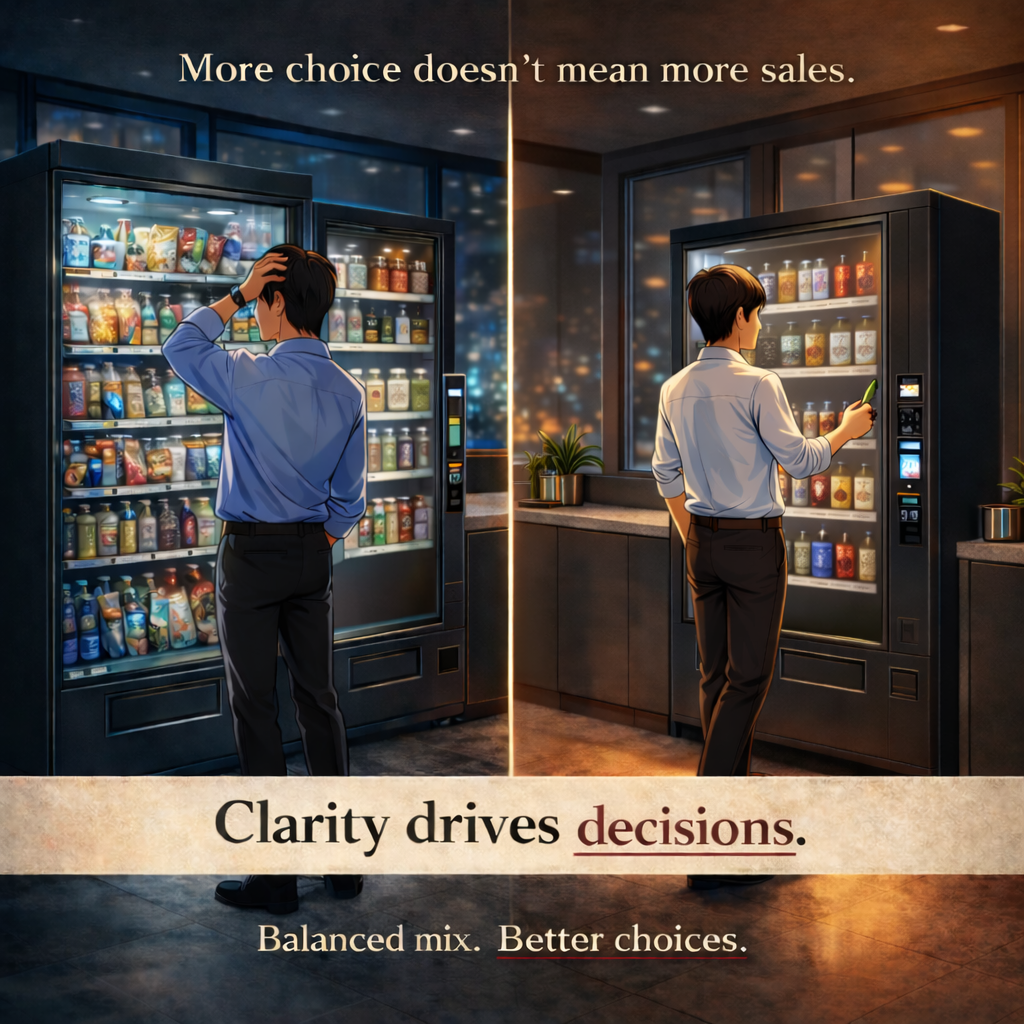
Too many options create hesitation. Clarity drives decisions.
More choice creates friction
It sounds counterintuitive.
More options should mean more sales, right?
In reality, it often does the opposite.
When people are faced with too many choices:
🟩 They hesitate
🟩 They take longer
🟩 They default to nothing
In a workplace or apartment setting, that hesitation is everything.
Because vending is about quick decisions.
What actually works: clarity
The highest-performing setups don’t try to offer everything.
They focus on balance:
🟩 Familiar favorites people trust
🟩 Better-for-you options people feel good about
🟩 Functional items people actually need (protein, hydration, energy)
That mix does something simple but powerful:
It makes choosing easy
And easy decisions drive usage.
Why this matters for property managers
From the outside, a fully stocked machine can look like a success.
But inside the data, a different story often shows up:
🟩 Slower product turnover
🟩 Lower daily usage
🟩 More expired items
🟩 Less engagement overall
A curated setup, on the other hand:
🟩 Moves faster
🟩 Feels cleaner
🟩 Creates repeat usage
🟩 Reduces operational issues
And importantly:
It requires less oversight, not more
The real goal isn’t variety
It’s performance.
A great vending setup isn’t measured by how many products it offers.
It’s measured by:
🟩 How often it’s used
🟩 How quickly products move
🟩 How easy it feels for residents or employees
That’s the difference between:
“We have a vending machine,” and “This actually works.”
Final thought
Most vending setups don’t fail because of the machine.
They fail because the experience creates friction.
And in vending, friction kills usage.
Clarity drives decisions.
And decisions drive results.
Why Vending Fails (and It’s Not the Machine)
It’s about alignment—placement, product mix, and ongoing attention.
Most vending setups don’t fail because of the machine.
They fail because the interests aren’t aligned.
A property manager wants happy residents, fewer complaints, no extra workload, and a clean, reliable amenity.
A good vending operator wants high usage, fast product turnover, fewer service issues, and a setup that actually works.
Those are the same goals.
But here’s where things can start to drift:
1) Placement
An operator might place a machine where it’s easiest to install.
A property manager needs it where residents actually stop.
🟩 Near the package/mail area
🟩 In the natural lobby flow
🟩 Close to lounge or gym entrances
If people have to look for it, they won’t use it.
2) Product mix
An operator might default to what’s easy to source or historically “safe.”
A property needs a mix that reflects real behavior.
🟩 Familiar favorites people trust
🟩 Better-for-you options people feel good about
🟩 Functional items people actually need
This is where many setups slowly lose relevance if nobody adjusts.
3) Ongoing attention
Some setups are treated like “install and move on.”
But vending only works if it evolves.
🟩 Regular restocking before it looks empty
🟩 Quick response when something breaks
🟩 Adjustments based on what people actually buy
That’s the difference between “we have vending” and “this actually works.”
When placement, product mix, and service stay aligned, vending becomes a real amenity.
When they don’t, it becomes background.
What to Look for When Choosing a Vending Operator for Your Property
Choosing the right vending operator can quietly elevate your property’s day-to-day experience. Choosing the wrong one can create a low-grade headache: empty machines, slow responses, outdated equipment, and a “set it and forget it” attitude that shows.

Choosing a vending operator isn’t about placing a machine — it’s about service, tech, and ongoing optimization.
Here’s what actually matters when you’re evaluating operators.
1) Full-time vs. half-time commitment
Is vending their main focus—or something they do on the side?
A full-time operator is more likely to be consistent, responsive, and proactive. When vending is a side gig, service often becomes reactive: restocks slip, maintenance takes longer, and the program stalls.
2) Network collaboration
Does the operator work with other vendors in a network?
Operators who collaborate tend to have better access to parts, service knowledge, product sourcing, and real-world learnings from other properties. It’s a signal that they’re plugged into a broader ecosystem rather than reinventing everything on their own.
3) References and a proven track record
Ask for references. A strong operator is proud to share success stories.
You don’t just want “they installed a machine.” You want:
Did they keep it clean and stocked? Did they respond quickly? Did residents actually use it? Did the property manager feel supported?
4) Choosing the right machine (not just placing a machine)
A good operator doesn’t show up with one default solution.
They ask questions first:
🟩 Who will use it (residents, staff, visitors)?
🟩 What are the hours and traffic patterns?
🟩 Where will it be placed, and how visible is it?
🟩 Do you need snacks, beverages, essentials—or all three?
The right machine is about fit: tech, size, style, and placement.
5) Local partnerships and responsiveness
Local operators who build local relationships often deliver a better experience.
That usually means fresher product options, quicker restocking, and faster issue resolution. Local responsiveness matters—especially when a machine is down, or a product mix needs adjustment.
6) Smaller operators vs. national giants
Big national operators can be consistent—but they can also be rigid.
Smaller operators often win on:
🟩 faster adjustments
🟩 more flexibility
🟩 shorter or friendlier agreements
🟩 fewer strict minimum-sales requirements
The best operator feels like a partner, not a vendor you have to chase.
7) Tech integration
Modern vending is not just a machine—it’s the experience around it.
Look for:
🟩 cashless payments (tap + mobile wallet)
🟩 app-based features
🟩 simple user support
🟩 clear accountability for outages and refunds
Tech-forward operators reduce friction and immediately improve the resident experience.
8) AI-optimized product mix (data-driven improvement)
The best vending programs don’t stay static.
Data-driven operators refine the product mix over time based on real usage. That means fewer dead items, fewer stockouts, and a machine that feels increasingly “right” for the property.
The takeaway
The best vending operator is a partner: committed, responsive, tech-forward, and always improving the program based on what your residents or employees actually want.
If you’re evaluating vending operators, use this checklist, and you’ll quickly separate the “machine placers” from the operators who actually elevate your property.
Smart Snacks Vending Machines: Why “Healthy” Alone Doesn’t Work (Balance Does)
“Can you make it healthy?”
We hear that a lot. And we agree with the intent.
But here’s what most people miss:
A smart snacks vending machine doesn’t succeed because it’s healthy.
It succeeds because it’s useful — and keeps earning trust over time.
If the mix feels like a lecture, people stop using it.
If it feels like a grab-and-go store with options for everyone, it becomes part of the routine.
The problem with “healthy-only”
A healthy-only machine usually fails for simple reasons:
🟩 People don’t like being told what to buy
🟩 New brands feel risky when you’re hungry and busy
🟩 The “safe picks” disappear (and so does habit)
When someone approaches a machine, they want one of two things: comfort or function.
What balance looks like
The best-performing mix usually has three layers:
🟩 Core favorites (habit builders): familiar items people trust and buy without thinking
🟩 Better-for-you options (credibility builders): recognizable brands that feel “cleaner” and still taste good
🟩 Functional items (problem solvers): protein, electrolytes, low-sugar energy, quick fuel for busy days
That combination creates repeat usage. And repeat usage is what makes vending feel like an amenity instead of a gamble.
Why “smart” matters
Smart vending isn’t just a nicer machine. It’s a program.
We can see what’s moving and adjust fast:
🟩 what sells daily vs. occasionally
🟩 which items get tried once vs. bought again
🟩 what runs out first (and what never moves)
The takeaway
Healthy is great — when it’s part of a mix people actually want.
The goal isn’t to eliminate the classics. It’s to raise the quality of the options without breaking the habit.
That’s what modern smart snacks vending machines do best: they meet people where they are, and improve the experience over time.
The 2 AM Problem: Why Hotels Are Turning to Smart Vending Instead of Room Service
Every hotel has the same moment.
It’s late. The lobby is quiet. Staff is running lean.
And a guest comes down looking for something simple:
Water. A snack. A toothbrush. Cold medicine. A charger.
Not a full meal. Not a restaurant experience. Just a quick fix — right now.
That gap is the 2 AM problem. And it’s exactly why more hotels are installing smart vending instead of relying on limited room service or a tiny sundry shelf that’s half-empty by day two.
What guests actually buy
Hotel guests aren’t trying to explore. They’re trying to reduce friction.
The best-performing mix is simple:
🟩 Cold beverages (water wins, always)
🟩 Familiar snacks (salty + sweet + a few protein options)
🟩 Essentials that save the stay (toothbrush, deodorant, wipes, chargers, feminine care)
One forgotten item can become a negative review.
One well-placed solution can become a “thank you” moment.
Why smart vending works in hotels
Traditional hotel retail struggles for three reasons:
Staffing reality — nobody has time to manage a mini-store
Inventory reality — empty shelves kill trust fast
Convenience reality — guests expect fast, cashless checkout
Smart vending fits how hotels operate today: lean teams, high expectations, 24/7 needs.
Placement is the multiplier
Put it where guests already flow:
🟩 near the front desk
🟩 by elevators
🟩 close to meeting/event spaces
🟩 near the gym entrance
If it isn’t easy to find, it isn’t doing its job.
The quiet upside: meetings & events
If your hotel hosts conferences, weddings, or group trainings, vending becomes a reliable add-on. Groups move in waves, and they buy in patterns: drinks + snacks + energy.
The bottom line
Smart vending isn’t about selling candy bars.
It’s about solving predictable guest problems — especially when everything else is closed.
If your property wants a simple way to offer 24/7 convenience without adding staff, this is one of the highest-impact upgrades you can make.
The All-In-One Comfort Package
When the weather turns colder, behavior changes.
People stay in more. Friends come over instead of going out.
Movie nights replace outdoor activities.
Comfort becomes the priority.
That’s when apartment amenities truly matter — not during work hours, but during the moments when residents are actually living their lives.
Vending in apartment communities has long been treated as a basic utility: a machine in a corner, stocked occasionally, rarely reconsidered. But residential behavior is very different from office behavior, and it deserves a different approach.
In apartments, convenience isn’t about speed.
It’s about comfort.
Residents use shared spaces in the evenings, on weekends, after workouts, and during colder seasons. They aren’t looking for endless choice or novelty. They want something familiar, easy, and reliable.
A cold drink everyone recognizes.
Classic snacks that feel like a treat.
Shareable options when friends are over.
These small details shape how a building feels day to day.
The most successful apartment vending setups aren’t defined by the number of products they offer. They’re defined by predictability. When residents know what they’ll find — and trust that it will be stocked — usage increases naturally.
Reliability creates comfort.
Comfort creates habit.
But comfort goes beyond snacks and drinks.
There are moments when residents need something unexpectedly: bottled water, basic personal items, simple health essentials. Having those items available inside the building turns vending into a quiet backup plan, eliminating late-night trips or unnecessary inconvenience.
That feeling of “it’s here if I need it” matters.
This is the idea behind the All-In-One Comfort Package.
Instead of treating apartment vending like office vending, this approach is designed around real residential rhythms. A familiar, hang-out-friendly mix of snacks and beverages forms the core, complemented by a carefully selected set of everyday essentials.
Behind the scenes, the system is continuously curated and optimized to stay clean, stocked, and reliable. From the resident’s perspective, it should feel simple and effortless.
Walk up. Grab what you need. Go back to your evening.
The best apartment amenities don’t call attention to themselves. They quietly remove friction and support everyday life.
Especially during colder months, that kind of reliability turns a vending machine into something more meaningful: a small but consistent source of comfort.
Because great apartment living isn’t about adding more features.
It’s about understanding how residents actually live — and making those moments easier.
The Art of Giving
Do you remember the opening scene of Love Actually?
The camera moves through an airport at Christmas time.
People arriving. People waiting.
Hugs. Smiles. Excitement.
No anger. No stress.
Just joy.
The narrator says something simple and powerful:
that when you look for it, love is actually all around.
That scene stayed with us.
Small Moments. Big Smiles.
Now fast forward to today — a workplace, a lobby, a breakroom.
A smart vending machine is stocked for the first time.
The doors close. The lights turn on.
And then something happens:
People gather.
They smile.
They point.
They tell each other what they like.
They give advice.
They laugh.
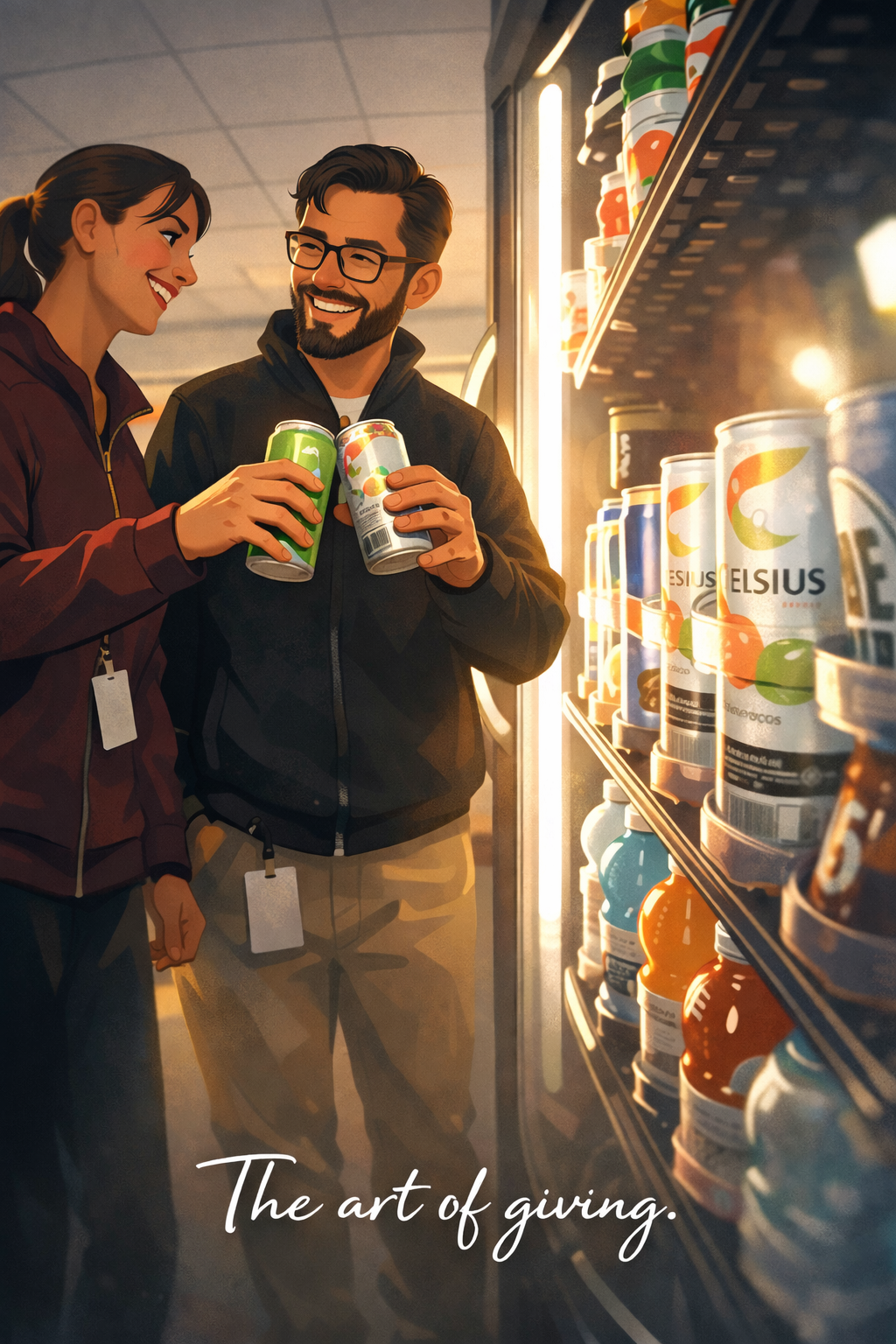
It looks a little like kids standing in front of a Christmas tree, unwrapping gifts together.
Someone grabs a drink and says,
“You have to try this.”
Someone else replies,
“Next one’s on me.”
And suddenly, it’s not about vending anymore.
It’s a shared moment.
Why This Matters to Us
At TraXXable, we spend a lot of time behind the scenes:
Listening.
Planning.
Optimizing.
Thinking ahead.
But the real reason we do what we do isn’t the technology.
It’s this.
🟩 The smiles when something new appears
🟩 The excitement of choice
🟩 Friends inviting each other for a treat
🟩 The feeling that someone thought about you
Those moments — that happiness —
That is our gift to you.
A Thank You
To everyone who trusted us this year.
To everyone who welcomed TraXXable into their workplace.
And to everyone who will discover us in the year ahead.
Thank you.
We wish you a holiday season filled with the people you enjoy most,
with moments of joy, generosity, and connection —
and with many small surprises along the way.
Because the art of giving isn’t about the gift itself.
It’s about how it makes people feel.
Happy Holidays from Twix 🐾and the entire TraXXable team.
What Employees Reach For First: The Surprising Psychology of Workplace Snacks
Stand in front of any breakroom for five minutes and you’ll see it:
people don’t choose randomly — they follow patterns.
We design every TraXXable machine around those patterns, then let AI fine-tune the mix for each location.
Mornings: Light Start & Hydration
Most people arrive slightly dehydrated and not ready for a heavy meal.
That’s why mornings lean toward:
🟩 Water and electrolyte drinks
🟩 Starbucks-style bottled cold drinks
🟩 Lighter bars or yogurt cups
They’re not “snacking” yet — they’re waking up their brain.
Midday: Real Food, Fast
Around lunch, convenience starts to matter as much as flavor.
This is when fresh food in the machine really earns its place:
🟩 Salads and grain bowls
🟩 Wraps and sandwiches
🟩 Protein-focused options
If it’s fresh, filling, and easy to grab between meetings, it moves.
Afternoons: Comfort & Fuel
Between 1–3 p.m., energy dips and decision fatigue hits.
That’s when people reach for:
🟩 Chips and chocolate
🟩 Energy drinks
🟩 Protein bars
They’re looking for a quick lift and something familiar.
How We Use This at TraXXable
We don’t load machines with generic “vending” items and hope for the best.
We:
🟩 Curate the initial mix by location type (office, lab, gym, school, etc.)
🟩 Add fresh food where it truly fits the daily rhythm
🟩 Use AI to learn from every purchase and adjust the lineup slot by slot
Each machine becomes a little smarter every week —
closer to what your people actually reach for first.
When the product mix matches real behavior,
teams feel seen, breaks work better, and waste goes down.
That’s why every TraXXable machine is curated —
and then continuously optimized — for the people standing in front of it.
The Silent Cost of an Unstocked Breakroom
Some workplace problems are loud.
An unstocked breakroom isn’t one of them — but it’s expensive.
When there’s nothing reliable to grab on-site, people improvise.
That “quick run” to a café or gas station easily turns into 10–15 minutes away from the desk.
Multiply that across a team and suddenly you’re losing hours of focus every week to something that should be effortless: getting a drink or a snack.
The Hidden Disruption
When the breakroom doesn’t deliver, people:
🟩 Leave the building more often
🟩 Break their concentration mid-task
🟩 Miss chances to bump into coworkers and collaborate
It looks harmless, but it quietly chips away at:
Productivity
Morale
Team connection
Why Convenience Shapes Culture
Breakrooms aren’t just about food.
They’re one of the few places where people from different teams naturally cross paths.
When the space is stocked, clean, and predictable, it becomes a small daily signal:
“We thought about you.”
That’s how culture is built — not just in all-hands meetings, but in the in-between moments.
How TraXXable Fixes the Leak
TraXXable machines are designed so “unstocked” stops being a problem:
🟩 AI-optimized product mix – top items stay in stock more often
🟩 Remote monitoring – issues are spotted before your team feels them
🟩 Regular maintenance and cleaning – machines look and feel reliable
🟩 Location-based curation – each site gets what its people actually want
It’s not about adding another perk.
It’s about removing a constant, low-level distraction.
When the breakroom works, your workday flows.
No extra planning. No extra effort. Just fewer hidden costs.
Ready to make “out of stock” a thing of the past?
Looking Ahead: The Future of Smart Vending in 2026
Every industry evolves.
Vending just happens to be evolving faster than anyone expected.
What used to be a mechanical transaction — a dollar, a snack, a click — is becoming something entirely new: a connected ecosystem that blends AI, sustainability, and human experience.
At TraXXable, we see 2026 not as another year of convenience — but as the moment convenience becomes intelligence.
1. Smarter Machines, Sharper Insights
By 2026, every vending unit will be a source of data — not just sales data, but behavioral patterns.
When people buy, how they buy, and what they reach for next will all help workplaces understand real human rhythms.
AI will no longer just restock machines — it will predict needs before they happen.
2. Personalized Experiences
Imagine your vending machine greeting you with suggestions based on your preferences — protein in the morning, hydration in the afternoon, a treat when you hit your step goal.
It’s not science fiction anymore.
The integration of apps, wellness tracking, and micro-personalization will make vending feel less like retail — and more like care.
3. Sustainability by Design
2026 will be the year companies stop talking about sustainability and start tracking it.
Our machines already reduce waste by adapting stock in real time.
The next step?
Smarter supply chains, recyclable packaging partnerships, and logistics that cut carbon without cutting service.
4. Hybrid Work, Hybrid Spaces
As flexible schedules become the norm, the workplace itself is fragmenting — smaller hubs, shared offices, multi-purpose lounges.
Compact, smart vending fits perfectly into this shift.
It brings convenience wherever people gather, not just where HR puts a fridge.
5. Technology With a Heartbeat
Even as automation accelerates, the heart of smart vending will stay human.
From our gifting features to adaptive product mixes, the goal remains simple:
Make technology feel personal.
Because the future isn’t about machines replacing people — it’s about machines that understand them.
2026: The Year of Intelligent Convenience
The smartest workplaces won’t just have vending machines.
They’ll have learning systems that respond to people — automatically, invisibly, intuitively.
That’s where we’re headed.
And at TraXXable, we’re already there.
The Break Isn’t a Luxury — It’s the Strategy
Some of the best ideas don’t happen in meetings.
They happen when someone steps away for a minute.
That pause — the walk to the vending machine, the chat by the cooler, the small reset —
that’s where collaboration begins.
At TraXXable, we’ve learned that the smartest workplaces aren’t defined by their square footage or tech stack — they’re defined by how they treat the moments in between.
Why the Break Matters
The science is clear: short breaks improve creativity, focus, and retention.
Companies that build micro-moments of rest into their culture see
🟩 31% higher productivity
🟩 44% better retention, and
🟩 up to 65% more innovation submissions (Harvard Business Review, 2025).
The takeaway?
The best performance tool in your office might be your breakroom.
Redefining the Space Between Work
Modern breakrooms aren’t just refresh zones anymore.
They’re where teams reconnect, where ideas collide, and where culture quietly recharges itself.
That’s why every TraXXable installation is designed around one simple idea:
Make the pause matter.
🟩 Always stocked.
🟩 Always spotless.
🟩 Always available — so the next great idea doesn’t have to wait for coffee.
The Strategy Hiding in Plain Sight
Productivity isn’t about pushing harder — it’s about designing smarter spaces.
When employees have effortless access to energy, hydration, and community,
engagement follows naturally.
That’s not a perk.
That’s a strategy.
Because the next big project might start with someone saying,
“Hey, want to grab a snack?”
The Break Isn’t a Luxury — It’s the Strategy.
That’s TraXXable.
A Gift You Can Taste: The Human Side of Smart Vending
It starts with something simple — a small gesture.
Someone staying late. Someone showing up early. Someone who’s been holding the team together quietly for weeks.
Most companies say thank you in words.
But sometimes, the best way to say it is with something you can actually taste.
That’s where the idea for our digital gifting feature began.
Not as a transaction — but as a moment.
A Modern Gesture
🟩 Through the TraXXable app, employees can send digital credits or “snack notes” to one another.
🟩 A quick thank you, a congrats, or a quiet I noticed what you did.
🟩 The recipient walks to the vending machine, scans their phone, and gets their gift — instantly.
No wrapping. No scheduling. No waiting.
Just a small spark of connection in a normal workday.
Technology With a Heartbeat
Our machines are smart, but the goal has never been automation for its own sake.
It’s about amplifying the good parts of being human — gratitude, recognition, small surprises.
That’s why every feature we build, from AI-driven restocking to data analytics, has a human outcome in mind:
🟩 Making workdays easier.
🟩 Making people feel seen.
🟩 Turning ordinary moments into something just a little better.
Because convenience is great —
but connection is unforgettable.
Why It Matters
When people feel appreciated, they don’t just work harder — they care more.
They start to notice each other.
And that’s how culture quietly changes: one snack, one gesture, one “thanks” at a time.
The gift might be small.
But the message behind it is big.
Want to know more?