How HR Teams Can Use Smart Vending to Support, Incentivize, and Engage Employees
Vending is often treated as a convenience.
But with the right setup, it can become something much more practical:
A simple, scalable tool to support employees throughout the workday—without adding operational complexity.
For HR teams, the opportunity is not just in offering vending, but in how it’s used.
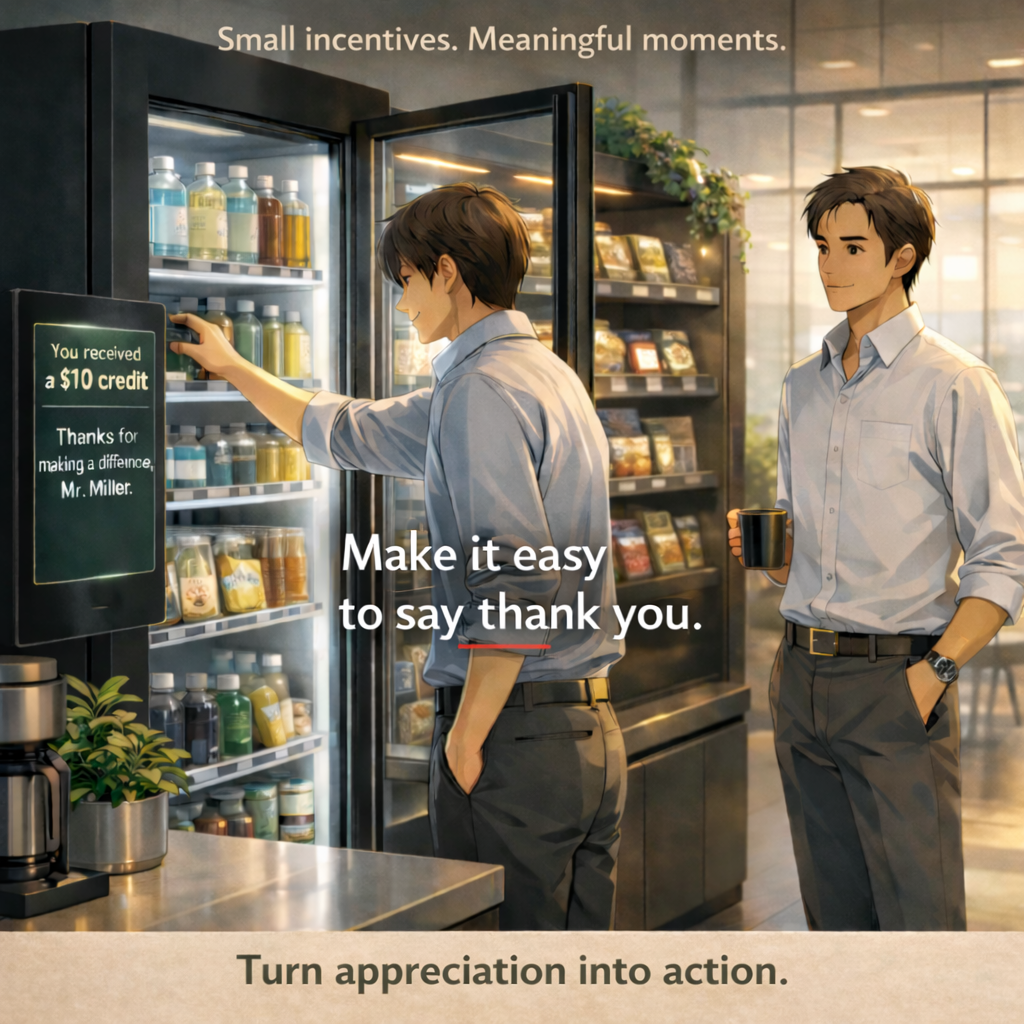
Recognition works best when it’s immediate.
Start with the goal, not the machine
Before introducing any solution, start with a simple question:
What do we actually want to achieve?
Is the goal to:
🟩 support healthier habits at work
🟩 improve day-to-day employee satisfaction
🟩 provide reliable access across multiple shifts
🟩 create simple incentives or recognition moments
🟩 strengthen communication in subtle, everyday ways
Different goals lead to different approaches.
When the goal is clear, the setup becomes much easier to design—and much more effective.
Think beyond snacks: use it as a tool
Modern vending setups, especially those connected to apps or digital systems, allow for much more than simple purchases.
They can be used as a lightweight engagement tool.
For example:
🟩 Team leads can allocate small credits to their teams
🟩 HR can create occasional “thank you” moments
🟩 Companies can support certain behaviors (e.g., long shifts, project milestones)
🟩 Onboarding experiences can include immediate, usable perks
These are not large programs.
They are small, repeatable actions that fit naturally into the workday.
Example: simple team-based incentives
In one common setup, managers are given a small monthly budget.
Instead of formal rewards, they use it informally:
🟩 recognizing extra effort during busy periods
🟩 supporting teams during longer shifts
🟩 offering small gestures after project milestones
Employees don’t need to request anything.
There’s no process to follow.
The credit simply appears—and can be used immediately.
This removes friction and increases actual usage.
Where apps make the difference
Without a connected system, most of this would be difficult to manage.
With app-based solutions, it becomes straightforward:
🟩 credits can be distributed instantly
🟩 usage can be tracked (at a high level)
🟩 limits and budgets can be controlled
🟩 access can be restricted to specific groups if needed
This allows HR teams to introduce incentives without creating new administrative work.
Match the setup to the workplace
Different environments benefit from different approaches.
For example:
🟩 office environments may focus on convenience and small daily perks
🟩 multi-shift operations may prioritize 24/7 availability and energy support
🟩 larger teams (150+ employees) can support broader variety, including fresh food
The key is aligning the setup with how employees actually work—not just what is available.
Keep it simple to sustain it
The most successful implementations share one common trait:
They don’t rely on ongoing effort.
🟩 no manual processes
🟩 no complex approvals
🟩 no additional workload for HR
Everything works in the background.
That’s what allows the system to scale and remain consistent over time.
Direct benefits for HR teams
When used intentionally, vending can support:
🟩 everyday employee satisfaction
🟩 small, meaningful recognition moments
🟩 improved convenience across the workday
🟩 a perk that is actually used—not just offered
🟩 engagement without additional programs
These benefits are subtle—but they compound over time.
Learn more about product strategy
The structure of the product mix plays a key role in how well a setup performs.
If you’re interested in how to approach this, we covered it in more detail here:
Why More Choice Doesn’t Mean More Sales (And What Actually Works Instead)
Final thought
The most effective employee perks are not the biggest ones.
They’re the ones that fit naturally into the day.
Smart vending, when used intentionally, becomes exactly that:
A simple system that supports employees—without adding complexity.
Contact
Want to know more? Reach out or drop a comment—we’re happy to share what’s working.
