The 27% Trap: Why Chips and Sodas Matter More Than Their Sales Suggest
Here's a grocery store secret most people never notice.
Milk sits at the back of the store on purpose. Not because it's unpopular, but because it's one of the most reliable purchases in the store. Grocers know people will walk the aisles to get it, picking up a few extra items along the way.
One product on the shopping list becomes six in the cart.
There's a name for this: milk is a traffic driver. Its job isn't just to sell milk. It's to create visits that lead to additional purchases.
Chips and sodas play the exact same role in a smart vending program.
Most people never think about them that way.
The right mix doesn’t happen by accident. Let TraXXable build and continuously improve the food program your workplace will actually use.
The Stat That Undersells Itself
Look only at direct sales, and chips and sodas seem like minor players.
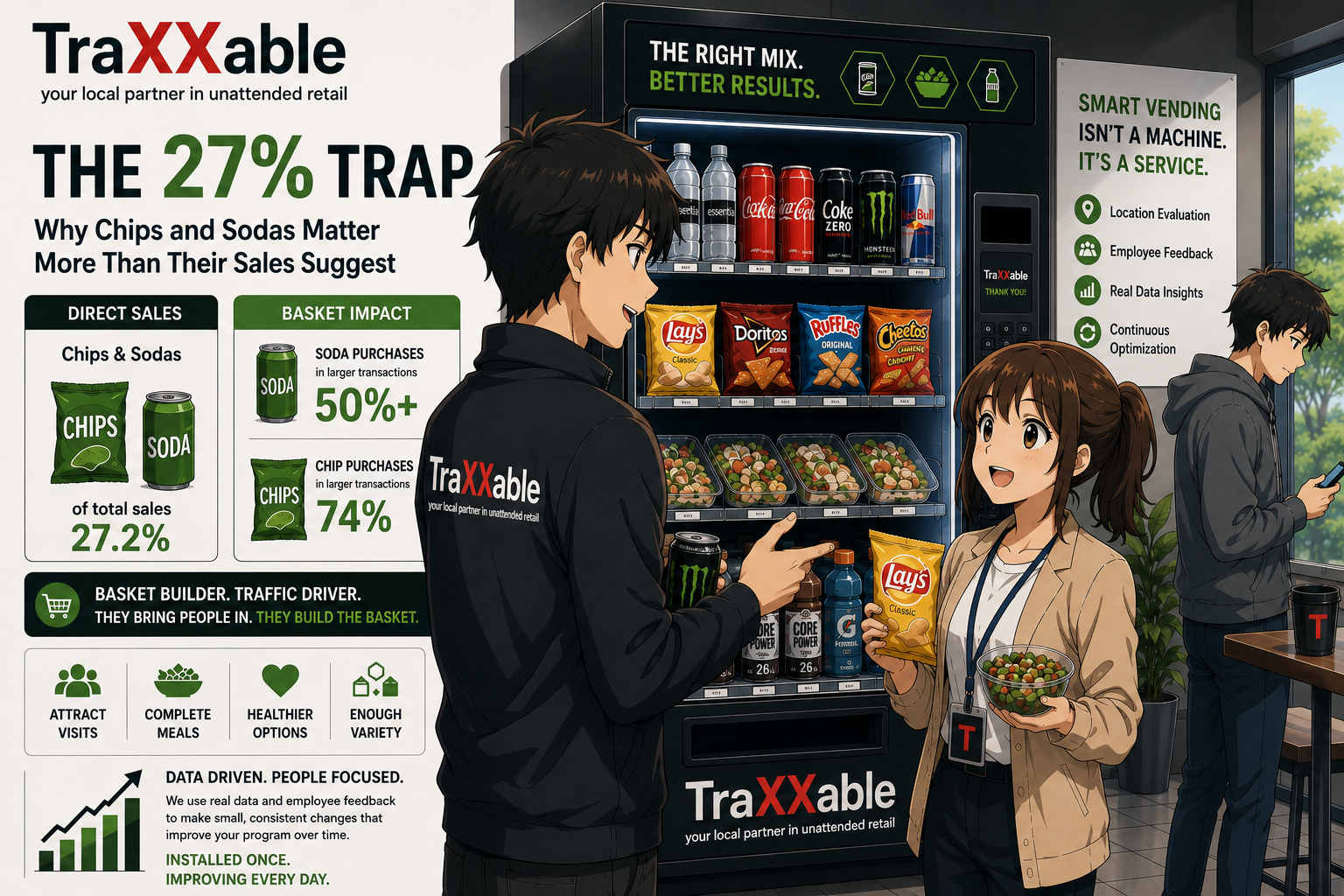
In one workplace analysis, they represented just 27.2% of total sales. On paper, that makes them look secondary, maybe even a category worth shrinking in favor of something "healthier."
The basket data tells a different story.
More than half of all soda purchases were part of a larger transaction. For chips, that number climbed to nearly three out of four.
That's not really about chips or sodas.
It's about what they unlock.
A soda turns a sandwich into a meal. Chips complete a fresh-food purchase. Someone walks over for the familiar item they already know they want. While they're there, they notice the protein snack, the salad, or the new product they hadn't planned to buy.
That's the real job chips and sodas are doing.
They're not just snacks.
They're basket builders.
Why "Healthy" Alone Isn't the Answer
A machine filled only with traditional snacks is limited.
But a machine filled only with healthier products often misses the same opportunity—because it removes the products that encourage people to walk over in the first place.
A healthier machine nobody visits isn't healthier. It's just ignored.
The strongest workplace food programs create balance.
🟩 Familiar drinks and snacks that attract visits.
🟩 Fresh food that turns a quick stop into a complete meal.
🟩 Healthier options for people actively looking for them.
🟩 Enough variety to keep the machine worth visiting.
The goal isn't to choose between healthy and familiar.
The goal is to build a product mix that makes both work together.
This Is Where Technology Becomes a Service
Every smart vending machine collects data.
Very few vending operators actually use it.
At TraXXable, we begin by evaluating the workplace itself: employee schedules, nearby food options, demographics, purchasing habits, and even employee questionnaires. That information helps us design the initial product mix.
Then the real work begins.
Every transaction teaches us something.
Which products attract visits.
Which products build baskets.
Which products quietly stop working.
Instead of making large changes once or twice a year, we make small, consistent improvements based on facts, not hunches.
Some products stay.
Some evolve.
Some are replaced,
The machine is installed once.
The food program keeps improving.
The Difference Between a Machine and a Service
Anyone can install a vending machine.
Building a successful unattended retail program is something very different.
It requires technology, transaction data, continuous optimization, and someone paying attention.
That's what turns a machine into a service.
And that's what allows a workplace food program to become smarter with every transaction.
Because the best vending programs aren't built on day one.
They're continuously refined, one improvement at a time
