The First 30 Days: Why a Smart Market Shouldn’t Look the Same a Month After Installation
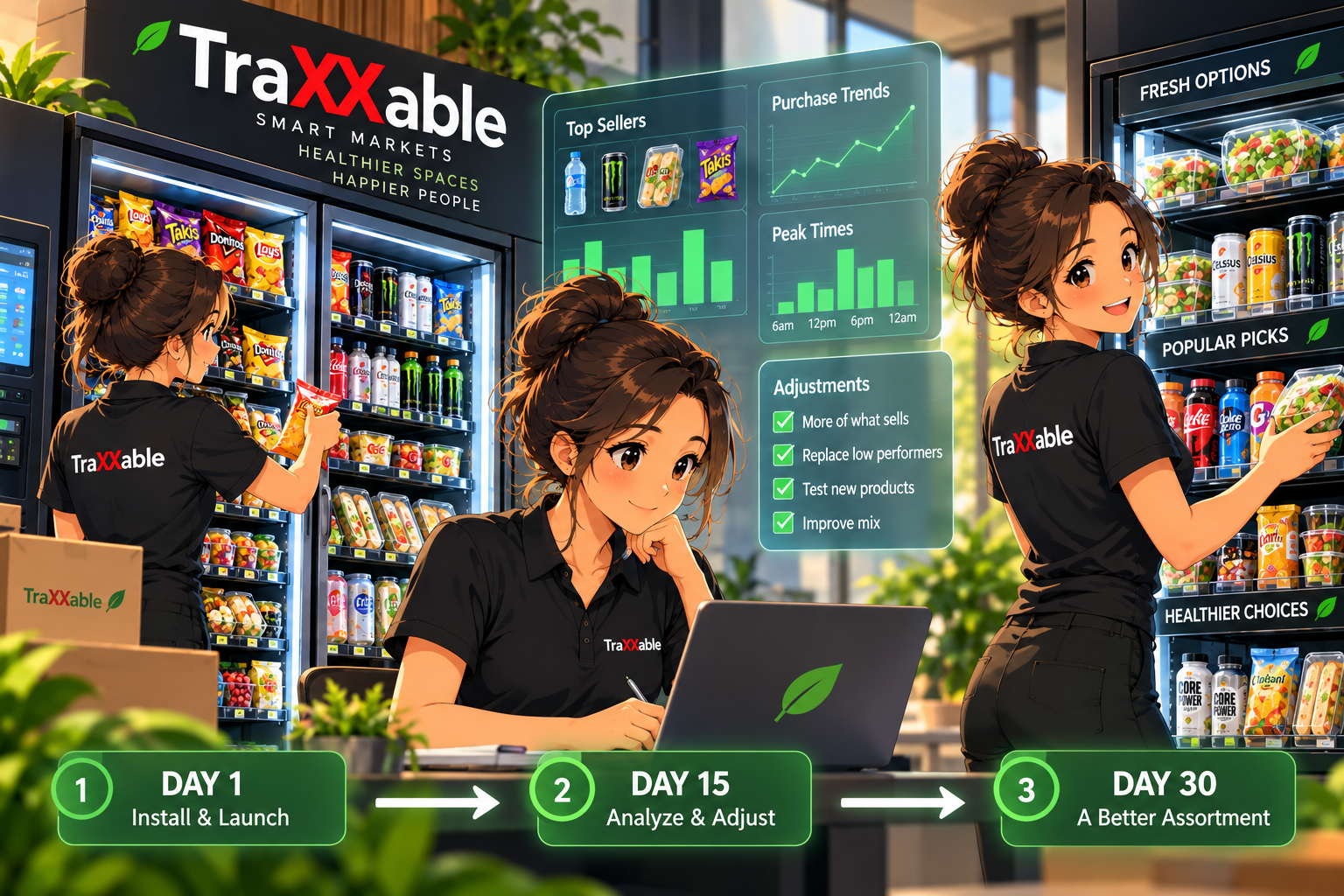
Installation day feels like the finish line.
The equipment is new. The shelves are full. The product mix has been carefully selected. Everything looks exactly as planned.
But from our perspective, that’s when the real work starts.
Because no questionnaire, demographic profile, or previous experience can tell you exactly how a specific group of people will shop.
The first 30 days can.
Day One Is an Educated Guess
Before opening a new TraXXable location, we do our homework.
Who will use it? When are they there? What food options already exist nearby? Are we serving residents, office employees, students, hotel guests, or a combination? What have they told us they want?
All of that helps us create a strong starting assortment.
But it is still a starting point.
People have a habit of surprising you.
The product everyone requested might barely move. Something we expected to sell moderately can suddenly need twice the space. A particular energy drink might dominate mornings, while fresh food performs almost entirely around lunch.
Until people start buying, we don't really know.
Then the Location Starts Talking
Every transaction adds another piece of information.
Not just what sold, but when it sold, what was purchased with it, how quickly it sold, and what customers repeatedly came back for.
Patterns begin to appear.
That's when optimization starts.
We don't react to every unusual day or immediately remove something because it sold slowly for a week. And we don't rebuild an entire assortment because one product suddenly had a great weekend.
We prefer small, consistent changes based on facts, not hunches.
Give a bestseller more space.
Replace a product that consistently underperforms.
Test a new flavor.
Adjust the balance between fresh food, beverages, snacks, and healthier choices.
Then watch what happens.
Why Small Changes Matter
Retail has a temptation to make big changes when something isn't working.
But big changes can also erase what’s working.
A smart market is a system. Products influence one another. Familiar items can drive traffic. Drinks and snacks can help build larger baskets. Fresh food may perform differently depending on what sits around it.
We've seen this in our own transaction analysis: categories that look small based on direct sales alone can play a much larger role in complete purchases.
That's why optimization needs patience.
Change. Measure. Learn. Repeat.
The Technology Makes This Possible. The Service Makes It Useful.
Modern unattended retail gives us access to information traditional vending never could.
But having data and using data are two different things.
That's where the operator matters.
At TraXXable, we use transaction data, customer feedback, and what we observe at the location to continuously refine the offering.
The goal isn't to find the perfect assortment on day one.
The goal is to build a better assortment on day 30 than on day one, and a better one six months later than on day 30.
That's why we don't view unattended retail as equipment you install and occasionally restock.
It's an ongoing service.
Your Market Should Learn With You
Workplaces change. Residents change. Seasons change. Preferences change. New products arrive.
Your retail amenity should be able to change with them.
So if your smart market looks exactly the same six months after installation as it did on opening day, there is a question worth asking:
Is anyone actually learning from what your customers are telling you?
The machine gets installed once.
The learning should never stop.
TraXXable — your local partner in unattended retail.
