
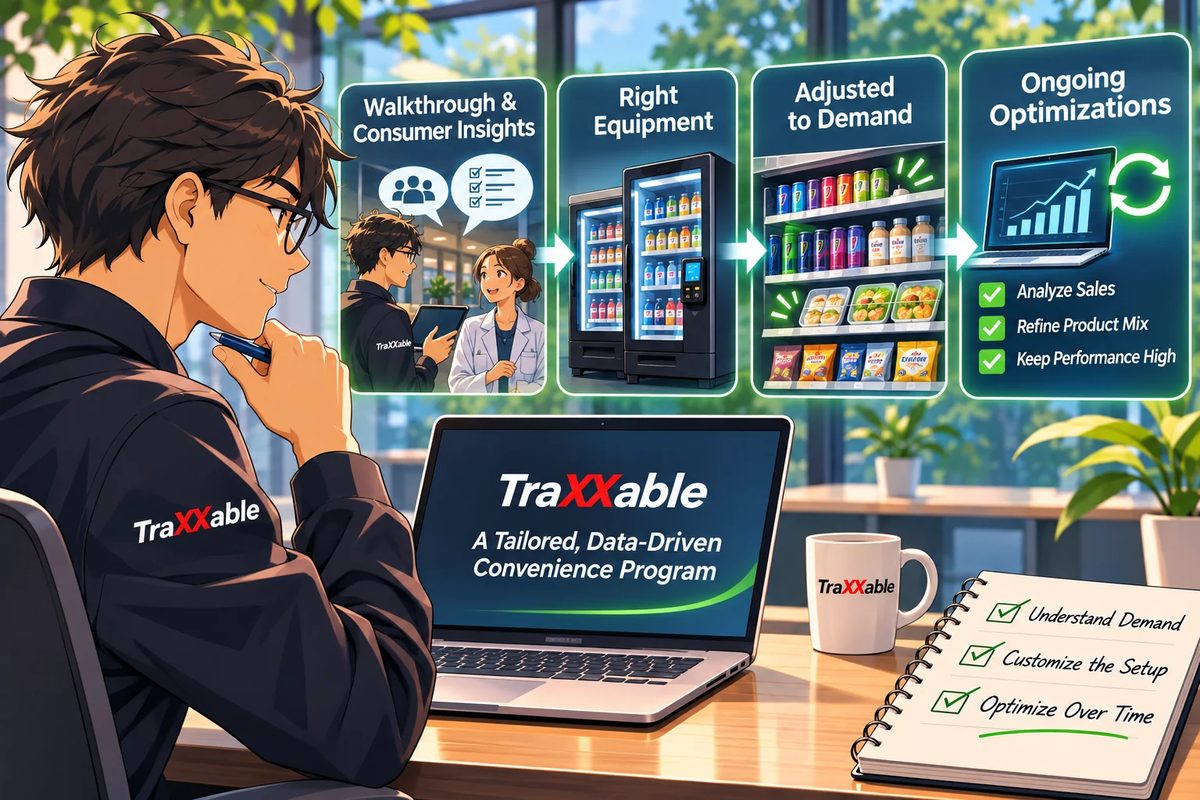
Installing a vending machine is easy. Making it a valued amenity takes considerably more thought.
For decades, vending has followed a relatively straightforward model: find a suitable location, install equipment, fill it with products, and return periodically to restock.
That model can work. But workplaces and residential communities have changed, and so have expectations.
Today, property managers and employers aren't necessarily looking for another machine. They're looking for a convenient, reliable service that makes their building a better place to work or live.
What gets installed: A machine — equipment, products, and a restocking schedule.
What people experience: An amenity — the placement, selection, and service that make it part of the day.
At TraXXable, we believe that distinction matters.
Placement Should Be About People, Not Just Available Space
A vending machine can be installed almost anywhere there's sufficient room and electricity.
But that doesn't mean every available corner is a good location.
Visibility, foot traffic, accessibility, and the natural movement of residents or employees all influence whether a market becomes part of someone's daily routine.
A machine hidden in a remote hallway may receive far less attention than one positioned near a lobby, breakroom, or other frequently visited area.
Our approach
We evaluate how people actually use a space before recommending where equipment should go.
The goal isn't simply to find room for a machine. It's to make convenient food and beverages part of the property's everyday experience.
The Right Product Mix Is Never Finished
Two buildings can have similar populations and completely different purchasing habits.
An office with early-morning shifts may have strong demand for coffee, breakfast items, and energy drinks.
An apartment community may see purchases throughout the evening, with residents looking for beverages, snacks, or a convenient meal.
Even within the same location, preferences can change over time.
That's why we don't believe in treating the initial product selection as permanent.
Our approach
We use location-level purchasing data to identify what sells, what doesn't, and where adjustments may improve the selection.
Rather than relying exclusively on assumptions, we let actual customer behavior guide our decisions.
From the field · Sorrento Valley
Same industry, different tastes. When we installed a smart market at a biotech workplace in San Diego’s Sorrento Valley, we began with a product selection informed by what had worked at another nearby life sciences company. But the employees’ purchasing habits were different: demand leaned toward energy drinks, protein snacks, baked chips, and other fitness-oriented options. We adjusted the selection while keeping familiar snacks that continued to sell well. Even workplaces in the same industry, minutes apart, can have very different preferences. The initial assortment is a starting point; actual purchasing behavior shapes what comes next.
Restocking Should Follow Demand
Traditional vending routes often operate on predetermined schedules.
Regular service visits are important, but a fixed schedule alone doesn't always reflect how quickly individual products sell.
A popular beverage might sell out well before the next visit, while another product remains untouched.
Modern connected equipment makes it possible to monitor sales and inventory remotely.
Our approach
TraXXable combines remote monitoring with location-specific demand patterns to plan restocking and respond to changing purchasing behavior.
The objective is straightforward: keep popular products available while reducing unnecessary inventory and service visits.
Technology supports the process, but attentive local operations make it work.
The Equipment Should Fit the Property
Not every location needs the same vending solution.
A small office may benefit from a compact smart cooler. A residential community with more available space might be better served by a larger smart store. Other properties may need a combination of refrigerated and ambient products.
Choosing equipment before understanding the location can create unnecessary compromises.
Our approach
We select equipment based on the available space, expected demand, customer needs, and the overall appearance of the property.
The result should feel like a natural addition to the building, not an afterthought.
A Vendor Relationship Should Be Earned
Installing equipment is the beginning of the relationship, not the end.
Over time, property needs change. Employee populations grow or shrink. Residents request different products. A previously suitable location may no longer be ideal.
A good operator should be willing to respond.
At TraXXable, we offer flexible agreements, including a 30-day cancellation option, because we believe the ongoing quality of our service should justify the relationship.
Our approach
We focus on earning the opportunity to stay through responsiveness, performance, and continuous improvement.
Local Service Makes a Difference
When something needs attention, property managers shouldn't have to spend unnecessary time navigating service processes.
A malfunctioning machine, an inventory concern, or a product request should have a clear path to resolution.
Our approach
TraXXable operates locally in San Diego, providing a direct point of contact and hands-on management of our locations.
We believe the operator should be accessible, accountable, and familiar with the properties it serves.
Standard Vending vs. a Managed TraXXable Amenity
The difference isn't necessarily the technology inside the machine. It's how the entire service is managed.
A standard vending program | A managed TraXXable amenity |
|---|---|
Equipment placed where space is available | Placement designed around traffic and visibility |
Standardized product selection | Products adjusted using location-level sales |
Scheduled inventory checks | Remote monitoring and demand-based restocking |
Standard equipment formats | Equipment selected to fit the property |
Conventional vendor agreements | Flexible, performance-focused relationship |
Centralized service process | Direct local point of contact |
These are differences in operating philosophy, not universal descriptions of every vending provider.
The Real Product Is Convenience
A resident who can pick up a drink without leaving the building doesn't think about inventory systems.
An employee who can grab lunch during a short break doesn't care which technology operates the cooler.
And a property manager who doesn't have to worry about stocking, cleaning, or servicing equipment isn't thinking about vending routes.
They're experiencing convenience.
That's ultimately what a well-managed amenity should deliver.
At TraXXable, we use modern technology to support a simple, old-fashioned idea:
Good service means understanding what people need and being there when they need it.
The machine is only one part of that promise.