
What our experience serving vocational schools has taught us about the importance of flexibility in unattended retail.
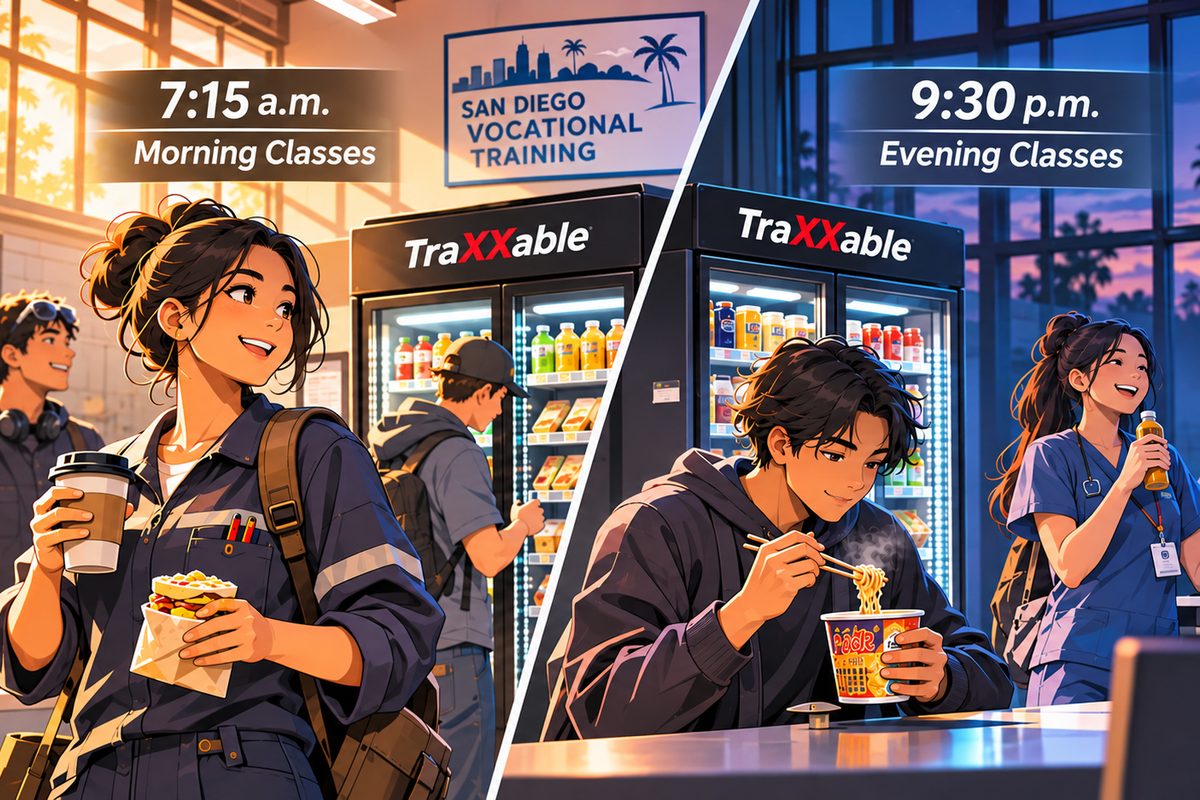
At one vocational school we serve, purchasing activity is concentrated between 7:15 and 9 a.m. At another, some of the busiest hours occur between 6 and 11 p.m.
Same industry. Very different purchasing patterns.
These differences illustrate why vocational schools are such an interesting environment for unattended retail and why a standardized approach to vending may not adequately serve their needs.
Structured breaks, extended class schedules, changing student populations, and diverse purchasing habits create a combination of requirements that makes vocational education distinct from many other industries we serve.
Same Industry, Very Different Purchasing Patterns
The differences between vocational schools extend well beyond the timing of purchases.
At locations with concentrated morning demand, breakfast options, coffee beverages, and products that students can conveniently grab before instruction begins become particularly relevant.
At locations with substantial evening attendance, we see demand for more filling food options. Ramen and protein-rich snack plates sell alongside traditional snacks and beverages, long after many conventional food service operations have closed.
Academic calendars also differ. Some programs operate with regularly rotating student cohorts and periods without scheduled instruction. Others generate more consistent demand across extended class schedules.
Each of these patterns influences how we operate a location:
- Morning-focused demand: Product availability before instruction begins is particularly important, with an assortment that accommodates breakfast and early-morning purchases.
- Evening-focused demand: Maintaining sufficient inventory throughout the day and providing more substantial food options become greater priorities.
- Fluctuating attendance: Inventory levels and restocking frequency need to reflect the academic calendar rather than follow a rigid service schedule.
These differences influence everything from equipment selection and product assortment to inventory management and service frequency.
The underlying technology may be similar, but the way we operate each location is not.
Somewhere Between a Workplace and a University Campus
Trade schools occupy a distinctive position between traditional workplaces and larger educational institutions.
Unlike many office employees, students cannot necessarily decide when to take a break. An entire class may have a limited window to purchase food, eat, and return to instruction.
Unlike students at larger universities, they may not have access to dining halls, cafeterias, or multiple food outlets within walking distance.
Many vocational students also balance their education with employment, family responsibilities, and financial commitments.
Traditional food service models do not always accommodate this combination of needs.
A staffed cafeteria may be difficult to justify economically, particularly when attendance fluctuates. Conventional vending provides convenient access to snacks and beverages but may offer limited meal options. Leaving campus can consume much of an already short break.
Modern unattended retail offers an opportunity to bridge that gap.
With smart coolers and smart stores, students can select multiple products in a single transaction, whether that is a beverage and a snack or a more substantial meal.
The market remains accessible throughout the school's operating hours without requiring dedicated food service personnel.
However, the technology itself addresses only part of the challenge.
Finding the Right Balance Between Affordability and Variety
A premium product assortment designed for a corporate office may not necessarily translate well to a vocational school. At the same time, limiting the offering to traditional vending products overlooks an opportunity to provide something more useful.
Students have different budgets, preferences, and reasons for making a purchase.
An affordable snack and a soft drink may be exactly what one student wants. Another may be looking for breakfast, a protein-rich snack, or an inexpensive warm meal before returning to class.
Where a microwave is already available on campus, the range of practical meal options expands considerably.
Instant ramen, breakfast sandwiches, and microwaveable meals can complement traditional snacks and beverages without requiring a commercial kitchen. Fresh sandwiches, wraps, and salads can also become part of the offering where purchasing patterns support them.
At TraXXable, we do not impose a standardized product assortment across all our locations. We curate each selection individually and continuously refine it based on customer preferences and actual purchasing behavior.
This flexibility is particularly valuable at vocational schools, where affordability, convenience, and access to more substantial food options need to work together.
Even within the same industry, the right product mix can look considerably different.
When the Customer Base Keeps Changing
In a conventional workplace, the same employees may visit a market for months or years. At a vocational training center, an entirely new group of customers may arrive every few weeks.
Programs begin and end. Enrollment changes. Holidays interrupt instruction. Different class schedules create different purchasing patterns.
For an unattended retail operator, these fluctuations have practical consequences.
Stocking too little can leave popular products unavailable during busy training periods. Stocking too much can create unnecessary waste, particularly when fresh food is involved.
Remote inventory monitoring and transaction data provide valuable insights, but they do not always explain why purchasing behavior changes.
A sudden decline in sales could indicate that a product is losing popularity. It could also simply mean that a training program has ended and the next group of students has not yet arrived.
Removing a product based solely on declining sales could therefore be the wrong decision.
This is where the combination of data-driven inventory management and direct communication with the school becomes particularly valuable.
As a locally operated San Diego company, we can maintain direct relationships with the schools we serve, understand upcoming changes, and adjust product selection, inventory levels, and restocking frequency accordingly.
Rather than interpreting every change in purchasing behavior as a sales trend, we can evaluate it within the context of the school's actual operating environment.
At vocational schools, flexibility in day-to-day operations is not simply about improving sales. It is about maintaining a reliable amenity despite a changing environment.
The Equipment Is a Starting Point, Not a Permanent Decision
Predicting retail demand before an installation can be particularly challenging at vocational schools.
Enrollment provides a useful starting point, but several other factors influence the appropriate setup:
- How many students are on campus simultaneously?
- How long are their breaks?
- Are there evening programs?
- What food alternatives are available nearby?
- How much demand is there for meals rather than snacks?
TraXXable works independently of individual equipment manufacturers and offers multiple unattended retail formats.
This allows us to select equipment based on the school's requirements rather than the limitations of a particular machine.
A smaller training center may be well served by a single smart cooler. A larger vocational college may benefit from a smart store with greater capacity or a combination of refrigerated and ambient equipment.
The initial installation does not need to anticipate every future requirement.
As purchasing patterns become clearer, the product assortment can evolve. If demand exceeds the capacity of the existing equipment, we can expand or adjust the installation without additional equipment investment by the school.
This is particularly relevant for institutions whose enrollment and training programs may look considerably different a year from now.
The Economics of Providing a Student Amenity
What makes vocational schools particularly challenging from a food service perspective is that demand can be too concentrated and variable to support a staffed cafeteria, yet too diverse to be adequately served by conventional vending.
A cafeteria has infrastructure, staffing, and operating costs that need to be supported by relatively consistent demand.
Traditional vending operates with lower overhead but may not provide the variety or meal options students need throughout a long day.
A flexible, fully managed smart market can operate in the space between these two models.
The ability to adjust equipment capacity, product selection, inventory levels, and service frequency makes it possible to provide a broader food offering without the fixed overhead of a staffed food service operation.
| Consideration | Staffed cafeteria | Conventional vending | TraXXable's approach |
|---|---|---|---|
| Availability | Defined service hours | During facility access | During facility access |
| Product selection | Broad | Equipment-dependent | Individually curated |
| Meal options | Generally available | Equipment-dependent | Adapted to student demand |
| Retail capacity | Infrastructure-dependent | Operator-dependent | Scalable |
| Inventory management | School or food service provider | Operator | Fully managed and data-driven |
| Equipment investment by school | Potentially substantial | Agreement-dependent | None for qualifying locations |
| Contractual commitment | Agreement-dependent | Agreement-dependent | Month-to-month |
For qualifying schools, TraXXable provides the equipment, installation, inventory, restocking, maintenance, and ongoing service at no cost to the institution.
The school provides a suitable space and access to electricity.
Our month-to-month agreements with 30-day cancellation also reflect the realities of an environment where future requirements may change.
Schools can introduce an amenity without having to predict its long-term performance or commit to a particular retail solution for several years.
The responsibility for making the market work remains with us as the operator.
Where the Advantages of a Flexible Service Model Come Together
The principles behind TraXXable's service model have value across the different industries we serve. At vocational schools, however, their combined benefits become particularly apparent.
Independence from individual equipment manufacturers allows us to accommodate different campus sizes and layouts. Individually curated product selections address different student budgets and meal requirements.
Continuous, data-driven optimization, combined with direct local communication, helps us respond to changing student populations and academic calendars.
Scalable installations and flexible agreements accommodate uncertainty around future enrollment and training programs.
And a fully managed service allows schools to provide this convenience without taking on the responsibilities of operating a food service business.
What makes vocational education such a natural fit for our approach is not any one of these capabilities in isolation. It is how closely they interact.
Our experience serving vocational schools has reinforced a principle that applies across all our locations:
We adapt our retail solutions to the location, rather than expecting the location to adapt to our retail solutions.
At trade schools, that flexibility is not simply a desirable feature. It is fundamental to delivering a successful convenience amenity.
Supporting the Next Generation of Skilled Professionals
Trade schools play an important role in preparing the next generation of electricians, HVAC technicians, welders, healthcare professionals, and other skilled workers.
Their students invest considerable time and energy in building their careers, often while balancing responsibilities outside the classroom.
Convenient access to an affordable breakfast, a quick lunch, or a warm meal during evening classes may seem like a relatively small amenity.
But for someone with a demanding schedule and limited time between classes, it can make a meaningful difference in their day.
Providing that convenience should not require schools to divert resources away from their primary mission.
Trade schools focus on building careers. We make everyday convenience one less thing to worry about.
Frequently Asked Questions
Does a trade school pay for smart vending equipment?
For qualifying locations, TraXXable provides the equipment, installation, inventory, restocking, maintenance, and ongoing service at no cost to the school. The school provides a suitable space and access to electricity.
What happens if enrollment or class schedules change?
We adjust product selection, inventory levels, and restocking frequency to reflect changing demand. If demand grows beyond the capacity of the existing equipment, we can expand or adjust the installation without additional equipment investment by the school.
Can students purchase meals rather than just snacks and beverages?
Yes. Depending on demand and the facilities available, the assortment can include breakfast sandwiches, ramen, microwaveable meals, protein-rich snack plates, fresh sandwiches, wraps, and salads.
Does the school need to sign a long-term agreement?
No. TraXXable operates with month-to-month service agreements and 30-day cancellation, allowing schools to retain flexibility as their requirements evolve.
TraXXable provides fully managed smart vending, smart stores, and micro markets for vocational schools, colleges, workplaces, and residential communities throughout San Diego County.
TraXXable. Your local partner in unattended retail.